
You are setting up network infrastructure for an AI data center and must configure an Out-of-Band Management (OOBM) network. What is the primary operational advantage of establishing this separate management network?
Select an answer to reveal the explanation.
Short Explanation and Infographic
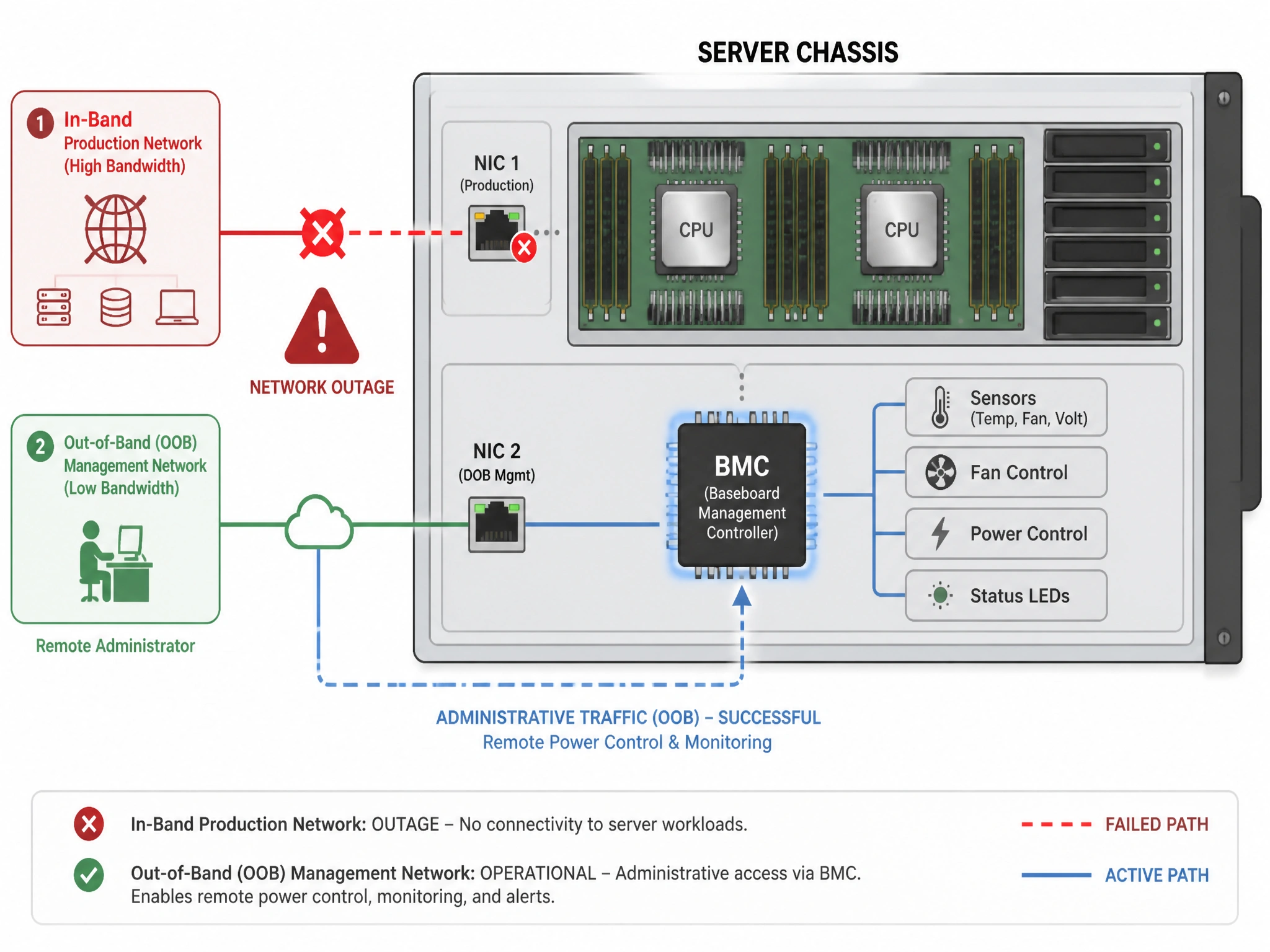
Imagine this: your main network switch gets flooded during a massive distributed training run, or a bad config locks you out of the production network. If you don't have Out-of-Band Management, you're stuck driving to the data center with a crash cart and a console cable. Not fun! OOBM gives you a dedicated backdoor—a separate network completely isolated from your production traffic. It hooks into the BMC (Baseboard Management Controller) on your servers, letting you monitor temperatures, check power, or force-reboot a hung server even when the main network is completely toast. It's a lifesaver, and it's absolutely standard practice in any enterprise deployment.
Full explanation below image
Full Explanation
Out-of-Band Management (OOBM) is a network administration technique that uses a dedicated, secure, and physically or logically isolated transmission path to manage network devices and servers.
In an AI data center, OOBM is critical because of the high density and complexity of the systems. The primary benefit is: - Independent System Access: If the primary (in-band) production network fails, becomes congested due to massive data transfers, or is misconfigured, administrators can still access the servers' management interfaces (such as IPMI, iLO, or iDRAC via the Baseboard Management Controller or BMC). This allows for remote troubleshooting, diagnostic log collection, power-cycling, and OS installation.
Let's address the distractors: - Performance Acceleration: OOBM operates on a low-bandwidth management network (often 1GbE). It does not carry application or training data and has no effect on LLM training speeds or NVLink traffic. - Automation of Physical Maintenance: While OOBM allows remote management, it cannot physically replace failed hardware components like GPUs, fans, or power supplies. Physical access is still required for hardware repair. - Workload Scheduling: Workload scheduling is handled by orchestration software like Kubernetes, not the OOBM network.