
A data center manager is preparing facilities for a new deployment of multi-node DGX clusters running continuous large language model (LLM) training. Which set of operational risks represents the most critical physical infrastructure challenges that must be mitigated for these high-density AI workloads?
Select an answer to reveal the explanation.
Short Explanation and Infographic
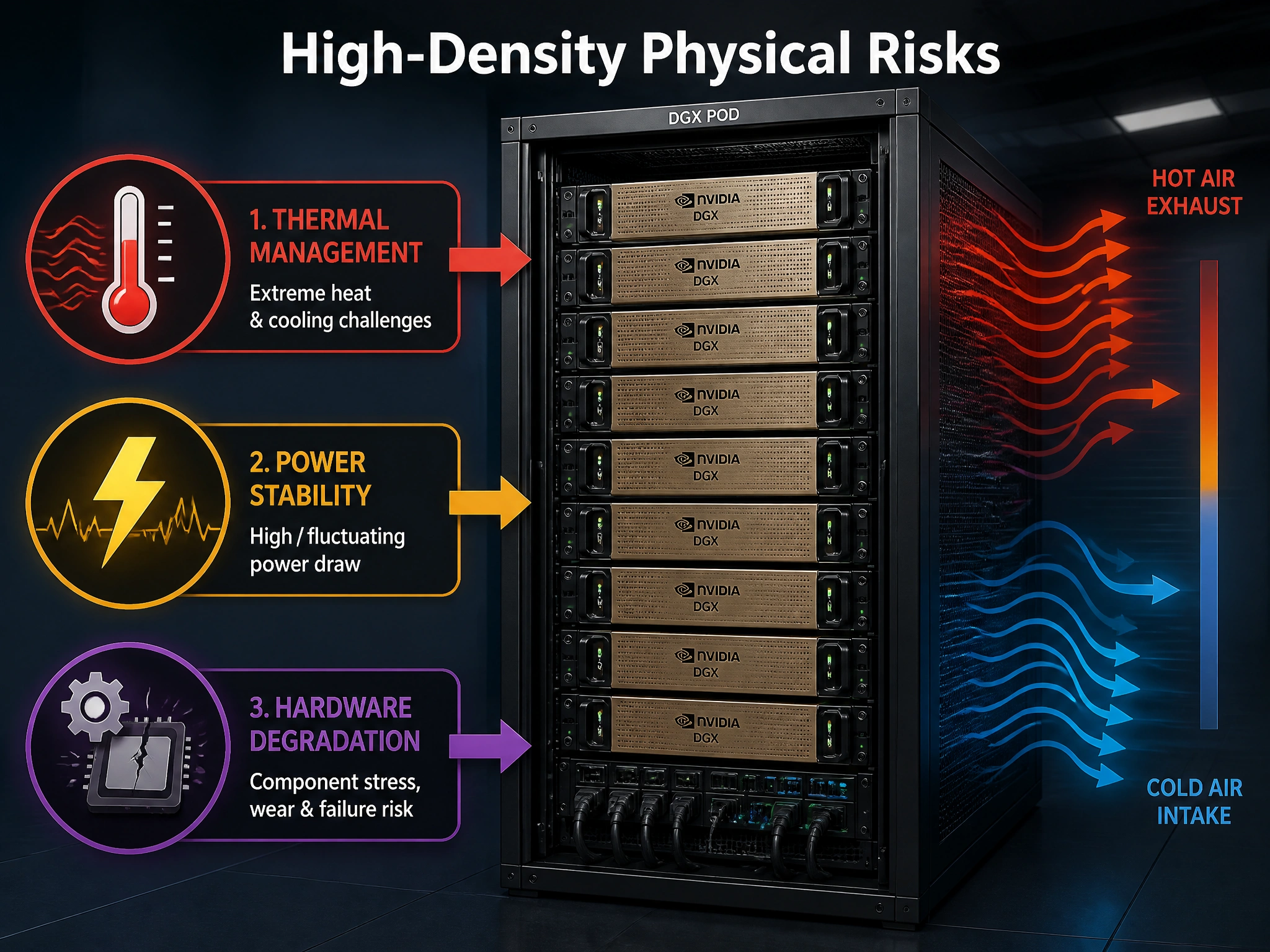
Okay, let's look at how this works in the real world. High-density AI servers—like a cluster of DGX nodes—are absolute beasts when it comes to power and heat. They pull massive amounts of current and generate enough heat to make a standard server rack look like an icebox. If your cooling fails, your expensive GPUs will thermally throttle (slowing your training to a crawl) or shut down entirely. If your power supply is unstable, you risk frying sensitive silicon. And running these systems flat-out at 100% load for weeks on end causes physical wear on the components. Licensing and documentation are operational challenges, sure, but they won't melt your hardware!
Full explanation below image
Full Explanation
High-density AI infrastructure deployments introduce extreme physical and facilities-level demands that go far beyond standard enterprise computing workloads. Data center operators must address three primary physical risks: 1. Thermal Management Failures: High-performance GPUs operating under full load (such as during LLM training) generate massive amounts of heat. Standard air cooling is often insufficient, requiring specialized containment, high-flow air systems, or liquid-to-air cooling loops. Inadequate cooling leads to thermal throttling (where GPUs reduce clock speeds to prevent damage) or thermal shutdowns. 2. Power Supply Instability: Modern AI servers pull several kilowatts of power per rack unit (a single DGX H100 system can draw up to 10.2 kW). Sudden shifts in workload intensity cause massive transient power spikes. Without robust power distribution units (PDUs), uninterruptible power supplies (UPS), and clean power delivery, these spikes can cause system instability or component damage. 3. Hardware Component Degradation: Running silicon at high temperatures and maximum power draw continuously accelerates electromigration and thermal stress, leading to premature failure of memory, power phases, and the processing cores themselves.
While data security, software licensing, and training are important operational considerations, they do not constitute the primary physical and facility-level risks unique to deploying high-density AI compute clusters.