
To collect real-time GPU telemetry, such as thermal metrics and memory utilization, from containerized workloads in a Kubernetes cluster and export them to a Prometheus database, which component is required?
Select an answer to reveal the explanation.
Short Explanation and Infographic
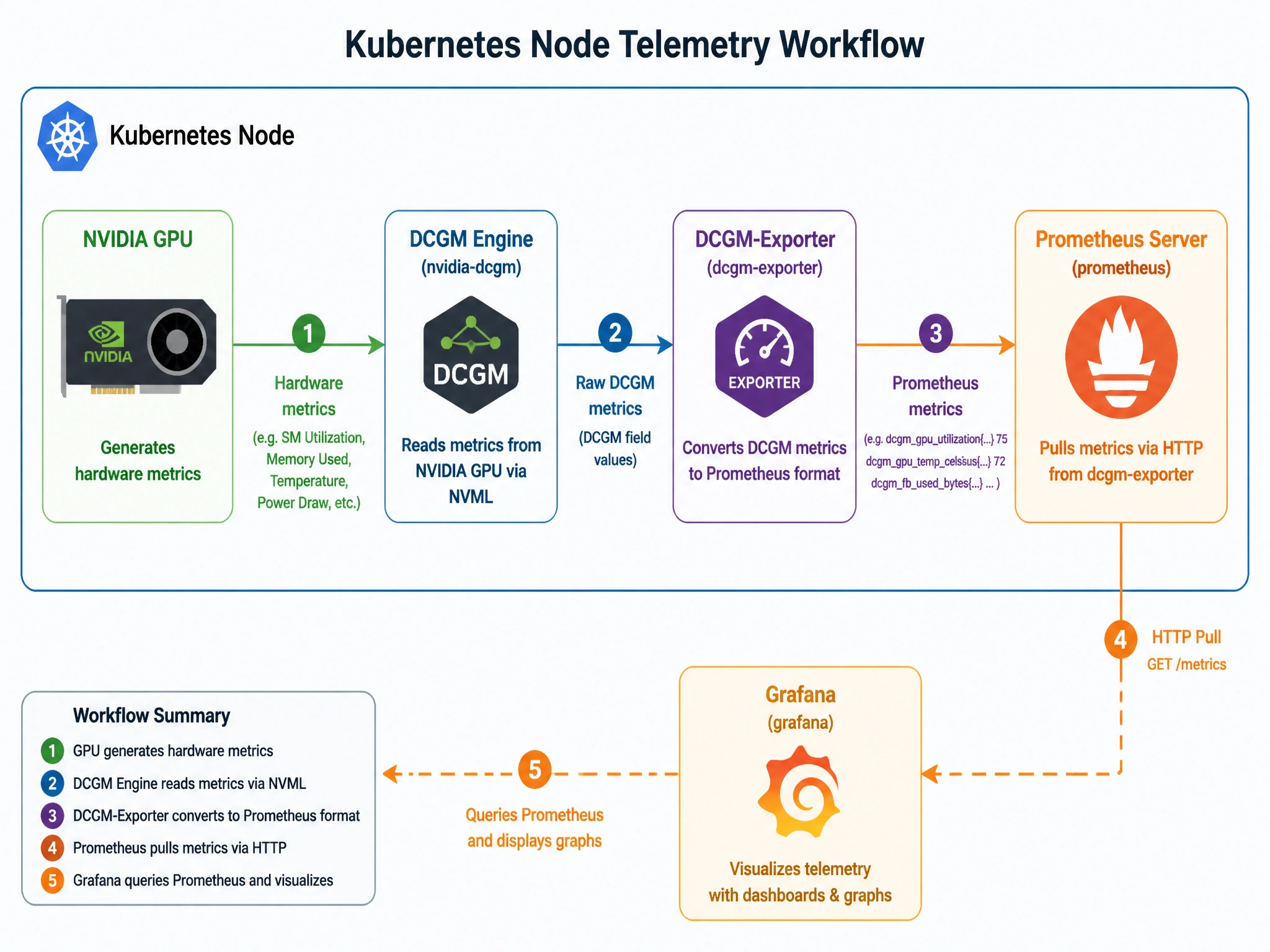
Think of it like this: you can't manage what you don't measure. If you have GPUs running in Kubernetes, you need to know their temperature, memory usage, and how hard they are working. NVIDIA has a tool called DCGM (Data Center GPU Manager) that reads all this juicy data directly from the hardware. But Kubernetes doesn't speak DCGM natively. That's why we need the DCGM-Exporter. It acts as a translator, taking those GPU stats and formatting them into Prometheus-style metrics so your dashboard can read them. What about the others? The GPU Operator packages everything together, the Device Plugin lets Kubernetes schedule GPU containers, and the MIG Manager splits physical GPUs into smaller instances. But for exporting telemetry metrics, the DCGM-Exporter is the star of the show.
Full explanation below image
Full Explanation
In containerized Kubernetes environments, managing and monitoring hardware health requires exposing hardware telemetry to cluster-wide monitoring frameworks like Prometheus and Grafana. The NVIDIA DCGM-Exporter is a tool that utilizes the NVIDIA Data Center GPU Manager (DCGM) engine under the hood. It collects low-level GPU metrics (e.g., SM utilization, memory usage, temperature, and performance throttle reasons) and exposes them via an HTTP endpoint in a Prometheus-compatible text format. The NVIDIA GPU Operator (Choice B) is a meta-operator that automates the deployment of all NVIDIA software components in Kubernetes, including drivers, device plugins, and the DCGM-Exporter itself, but it is not the specific telemetry exporter component. The NVIDIA Device Plugin (Choice C) allows Kubernetes to recognize and schedule physical GPUs to container pods but does not handle metrics export. The NVIDIA MIG (Multi-Instance GPU) Manager (Choice A) is used to partition physical GPUs into smaller virtual instances and manage their lifecycle, not for telemetry export.