
During distributed multi-node AI model training, how does NVIDIA GPUDirect RDMA optimize data transfers and reduce latency when GPUs on different servers exchange gradient updates?
Select an answer to reveal the explanation.
Short Explanation and Infographic
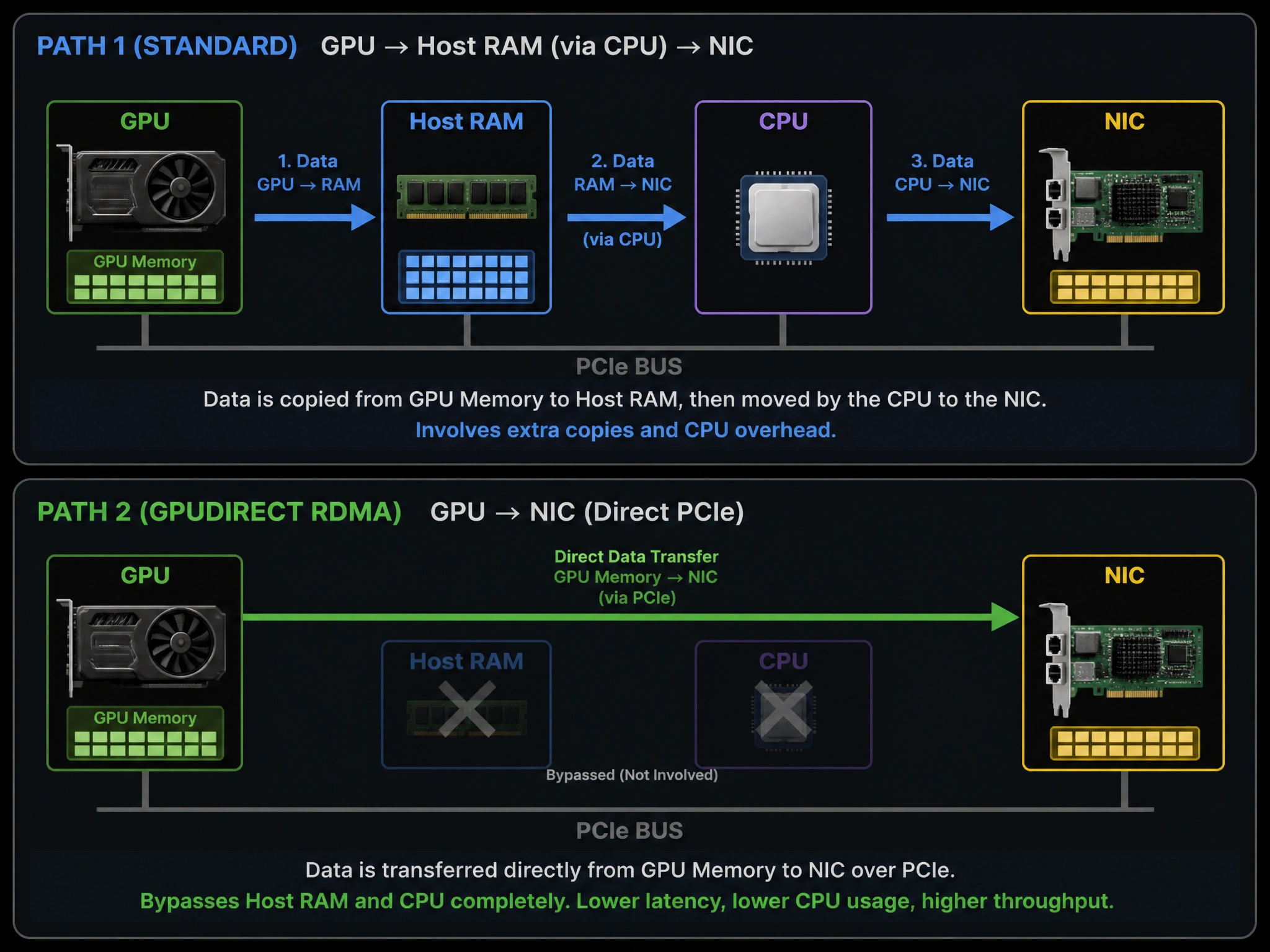
Now pay close attention here, because this one bites people in production all the time. When you are training a massive model across multiple servers, the GPUs have to constantly talk to each other to share what they've learned (their gradients). In the old days, to send data from GPU A on server 1 to GPU B on server 2, you had to copy it from GPU memory to system RAM, have the CPU process it, send it to the network card, and then do the reverse on the other side. Talk about a bottleneck! GPUDirect RDMA solves this by cutting out the middleman. It opens a direct pipeline over the PCIe bus between the GPU and the network interface card (NIC). The data goes straight to the wire, bypassing the host CPU and system RAM entirely. Less latency, faster training. It's that simple.
Full explanation below image
Full Explanation
GPUDirect RDMA (Remote Direct Memory Access) is a technology that significantly accelerates multi-node distributed deep learning workloads (such as those using MPI or NCCL). Normally, transferring data from a GPU on one node to a GPU on another node requires copying the data to host system memory (RAM), invoking the host CPU to manage the network protocol stack, sending the data over the network, and reversing the copy operations at the destination. This path introduces severe latency and memory bus congestion. GPUDirect RDMA allows a third-party PCI Express device (like a Mellanox InfiniBand or RoCE HCA) to directly access the memory address space of an NVIDIA GPU. This eliminates the intermediate system memory buffer copies and CPU overhead, allowing direct GPU-to-GPU data transfers across the network. Choice A is incorrect as network switches do not cache model gradients. Choice C is incorrect because GPUDirect RDMA does not natively compress data; it optimizes the physical transport path. Choice D is incorrect because link aggregation and parameter partitioning are functions of routing protocols and model parallel frameworks (like Megatron-LM), not GPUDirect RDMA.