
When architecting high-performance computing (HPC) environments and supercomputing clusters, what key architectural elements and capabilities make InfiniBand the go-to fabric over traditional networking? (Select all that apply.)
Select all correct answers, then click Submit.
Short Explanation and Infographic
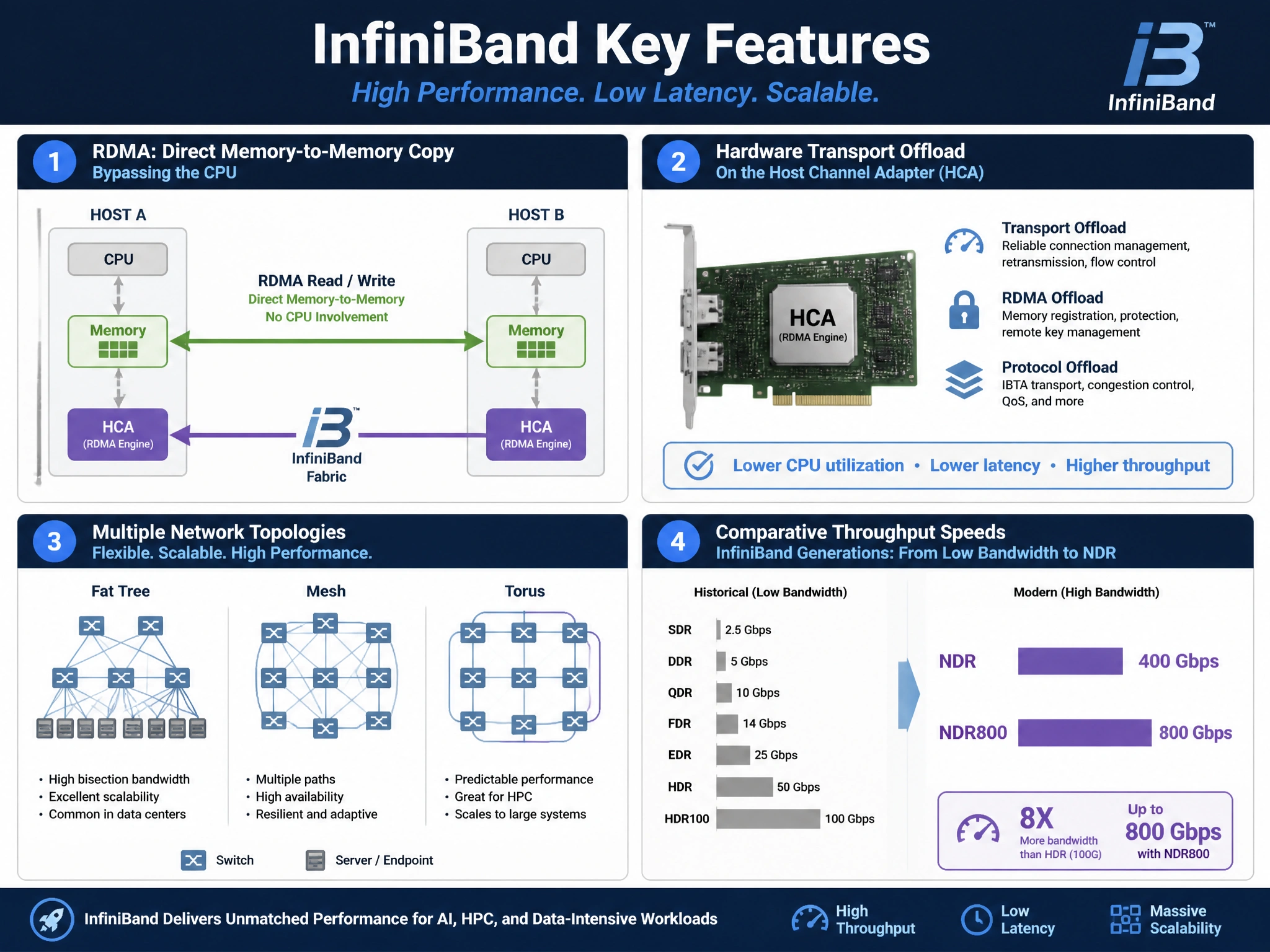
Here's the deal: if you want to build a supercomputer that actually runs at scale, you can't have your CPUs wasting precious cycles packaging up network frames. That's why InfiniBand is such a beast. Check this out: it offloads the whole transport stack right onto the host channel adapter (HCA) hardware, and it uses RDMA to copy data directly from one server's memory to another without the CPU even blinking. Add in adaptive routing, built-in QoS to keep high-priority traffic from getting stuck, and support for high-throughput topologies like Fat Tree, and you have a recipe for ultra-low latency. Oh, and if you thought InfiniBand maxed out at a measly 10 Gbps, think again! We are talking 200 Gbps HDR and 400 Gbps to 800 Gbps NDR ports today. So yes, that 10 Gbps limit is a total myth that will bite you on the exam.
Full explanation below image
Full Explanation
InfiniBand is the industry-standard fabric for High-Performance Computing (HPC) and large-scale AI clusters because of its hardware-driven design that minimizes latency and maximizes throughput. First, Remote Direct Memory Access (RDMA) allows network adapters to transfer data directly between application memories on different servers. By bypassing the operating system kernel and CPU entirely, RDMA cuts latency down to sub-microsecond levels. Second, transport layer offloading shifts network protocol processing (such as packet sequencing, acknowledgment, and retransmission) from the host CPU to the Host Channel Adapter (HCA) hardware. This frees up CPU cycles for actual HPC calculations. Third, InfiniBand utilizes a subnet manager that coordinates traffic and enables advanced features like adaptive routing, which dynamically routes around congested paths, and hardware-based error detection/correction to guarantee high reliability. Fourth, native Quality of Service (QoS) guarantees bandwidth and prioritizes latency-sensitive synchronization traffic over bulk storage transfers. Fifth, InfiniBand supports highly scalable topologies including Fat Tree, Torus, and Hypercube/Mesh configurations, ensuring high bisection bandwidth. Distractor E is incorrect because modern InfiniBand standards far exceed 10 Gbps; current HDR (High Data Rate) supports 200 Gbps per port, and NDR (Next Data Rate) scales up to 400 Gbps and 800 Gbps, making a 10 Gbps cap factually wrong.