
You're comparing GPU and CPU architectures from a deep-learning perspective, and you want to state the most accurate distinction. Which statement best captures the architectural advantage of GPUs over CPUs for AI workloads?
Select an answer to reveal the explanation.
Short Explanation and Infographic
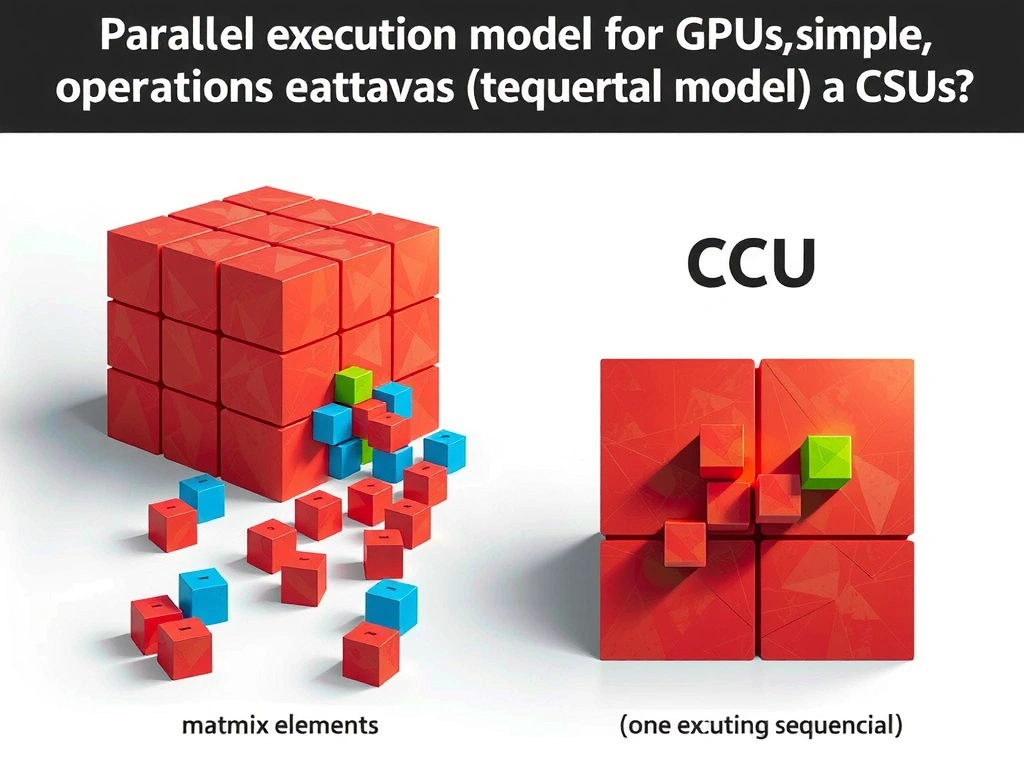
B is the fundamental architectural truth. GPUs excel at parallel tasks (thousands of simple operations simultaneously), CPUs at sequential complex tasks. A is true but secondary (bandwidth is important, but the parallel architecture is primary). C and D are false.
Full explanation below image
Full Explanation
The GPU vs. CPU distinction for AI comes down to architecture, not just performance metrics. CPUs are designed for sequential execution with complex instruction sets. They optimize for single-threaded performance and out-of-order execution. GPUs are designed for parallel execution with simpler instruction sets. They optimize for throughput across thousands of operations simultaneously. Deep learning consists of massive matrix operations that are highly parallel. Matrix multiplication of two 10,000×10,000 matrices involves 10^12 floating-point operations that can happen in parallel. A GPU can split these across its thousands of cores and compute them in parallel. A CPU with 8 cores has to serialize — execute them sequentially, which is orders of magnitude slower. This architectural difference is why GPUs are transformative for AI. Memory bandwidth (A) is important and GPUs typically have higher memory bandwidth than CPUs, but that's a secondary advantage. Clock speed (C) is unrelated — both GPU and CPU clock speeds are in the GHz range. The question drives home the fundamental architectural insight.