
Your infrastructure team is deploying Out-of-Band Management (OOBM) — a separate management network for infrastructure tasks. What's the practical value of OOBM in an AI infrastructure environment?
Select an answer to reveal the explanation.
Short Explanation and Infographic
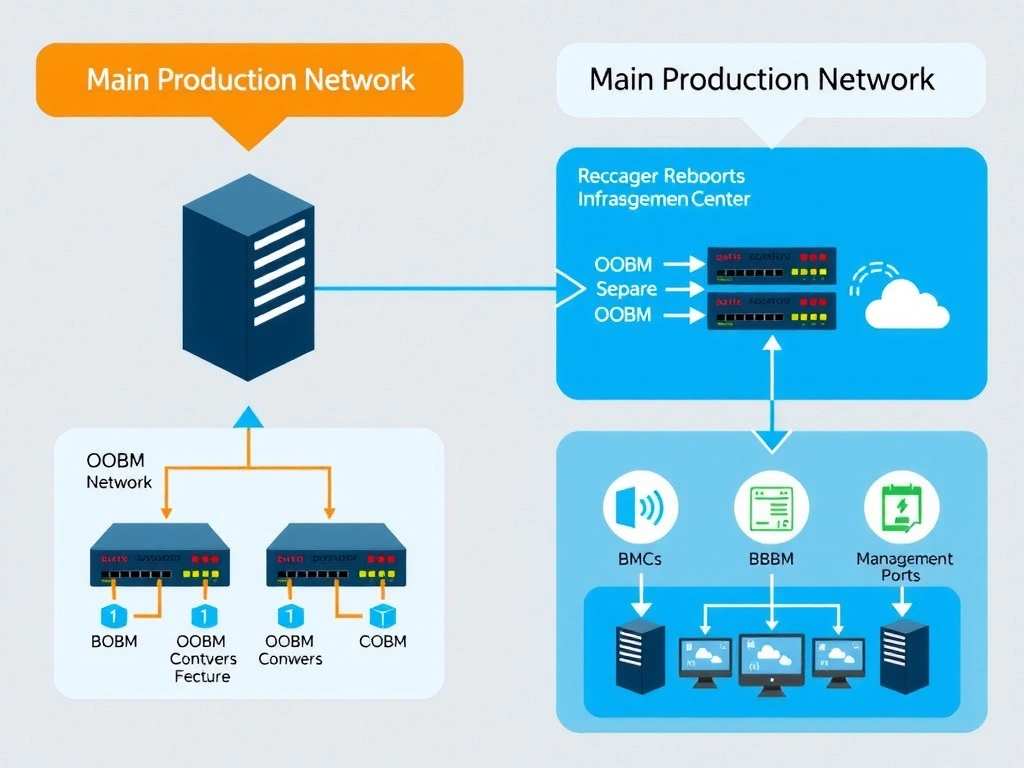
OOBM provides a separate channel for administrative access to infrastructure equipment. If the main production network fails or is congested, OOBM lets you access switches, routers, and servers for troubleshooting. A, B, and C are wrong — OOBM doesn't manage models, prioritize application traffic, or increase compute.
Full explanation below image
Full Explanation
Out-of-Band Management (OOBM) is a separate, dedicated network pathway for managing infrastructure equipment — switches, routers, servers, storage — independent of the main production network. It's typically implemented via: dedicated management ports on network equipment, a separate management switch, and a separate IP network (often a private network not directly connected to the internet). The value is independence: if your production network goes down or becomes congested, OOBM still works. You can SSH into a switch via OOBM and diagnose why the main network is broken. You can power-cycle a server via its BMC (Baseboard Management Controller) through OOBM if the OS is hung. In large data centers, OOBM is essential for high availability and troubleshooting. It doesn't manage AI models, prioritize application traffic, or increase compute. It's purely infrastructure administration.