
A customer is evaluating a multi-node AI cluster and asks: "Why do we need multiple nodes instead of just upgrading to the biggest single node possible?" What are the actual advantages of multi-node training?
Select all correct answers, then click Submit.
Short Explanation and Infographic
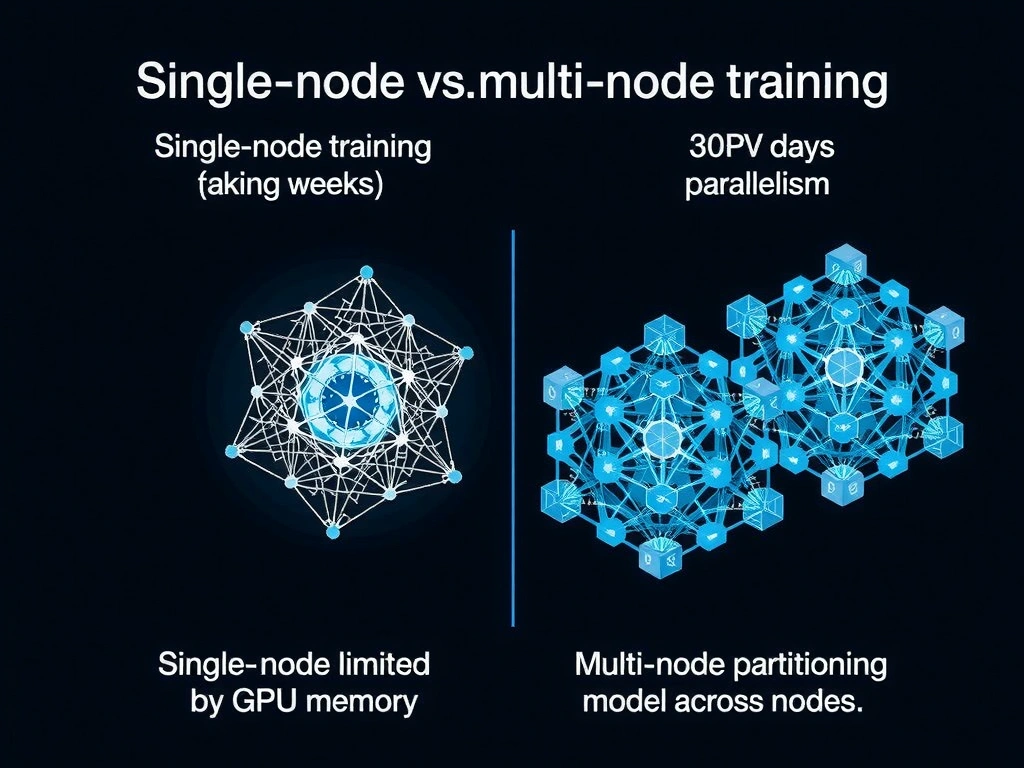
A and C are correct. Multi-node training reduces time (via parallelism) and enables larger models (via model parallelism across nodes). Model accuracy isn't inherently better with multi-node training. Ensemble training and inference serving are different use cases.
Full explanation below image
Full Explanation
Multi-node training has two core benefits. First: speed reduction. A large model trained on a single 8-GPU node might take weeks. With distributed training across 10 nodes (80 GPUs total), you can cut that to days. You're parallelizing computation across GPUs and nodes, dramatically accelerating training. Second: model size scaling. Some models are too large to fit in a single node's GPU memory. A 175-billion-parameter LLM might need 700 GB of GPU memory. Even with 8 × 80GB H100s (640 GB total), you're over budget. With model parallelism across multiple nodes, you can split layers across GPUs, fitting the model into aggregate memory. Now, why don't the other options work? Model accuracy isn't inherently improved by multi-node setup — accuracy comes from better algorithms, more training data, and better hyperparameters. Ensemble models are a different technique (training multiple diverse models). Inference serving is about throughput (how many predictions per second), not training architecture. The question tests whether you understand the actual reasons to use distributed training.