
Your development team is building microservices for an AI application, and you want to understand why everyone keeps pushing containers. What's the primary advantage containers bring to AI/ML development workflows?
Select an answer to reveal the explanation.
Short Explanation and Infographic
Containers solve the consistency problem. Your development environment, the training server, and production all run the same container image with the same dependencies. No more "works on my laptop but not in production." That's the win.
Full explanation below image
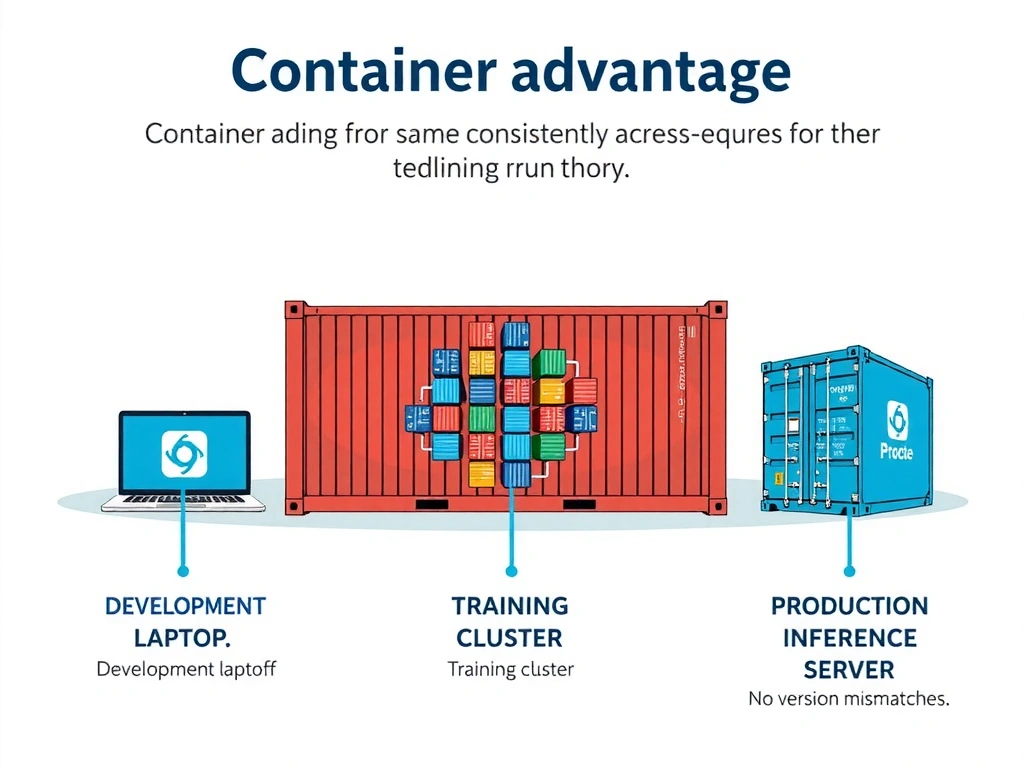
Full Explanation
Containers (Docker, Podman, etc.) are powerful in AI/ML because they solve an operational problem: consistency. A container packages your application code, all dependencies (Python libraries, system libraries, data preprocessing scripts), and the runtime into a single image. On your laptop, on the training cluster, in production — the container runs the same way. This eliminates a huge category of problems: "It works for me but not on the cluster," "We upgraded numpy and training broke," "The inference service uses a different Python version than training." With containers, those problems disappear. Containers don't create data, don't improve model accuracy, and don't make GPUs faster. Those are myths. What they do is make your workflows reproducible and portable. This is critical for AI because you want to train a model in a lab, package it in a container, and run it unchanged in production. Containers also enable orchestration platforms like Kubernetes to manage your workloads. Without containerization, you'd be manually sshing into servers and running processes — that doesn't scale.