
You're studying RDMA (Remote Direct Memory Access) to understand why InfiniBand deployments perform so well, and you want to pinpoint the specific feature that makes the biggest performance impact. Which aspect of RDMA most significantly reduces CPU utilization and cuts latency?
Select an answer to reveal the explanation.
Short Explanation and Infographic
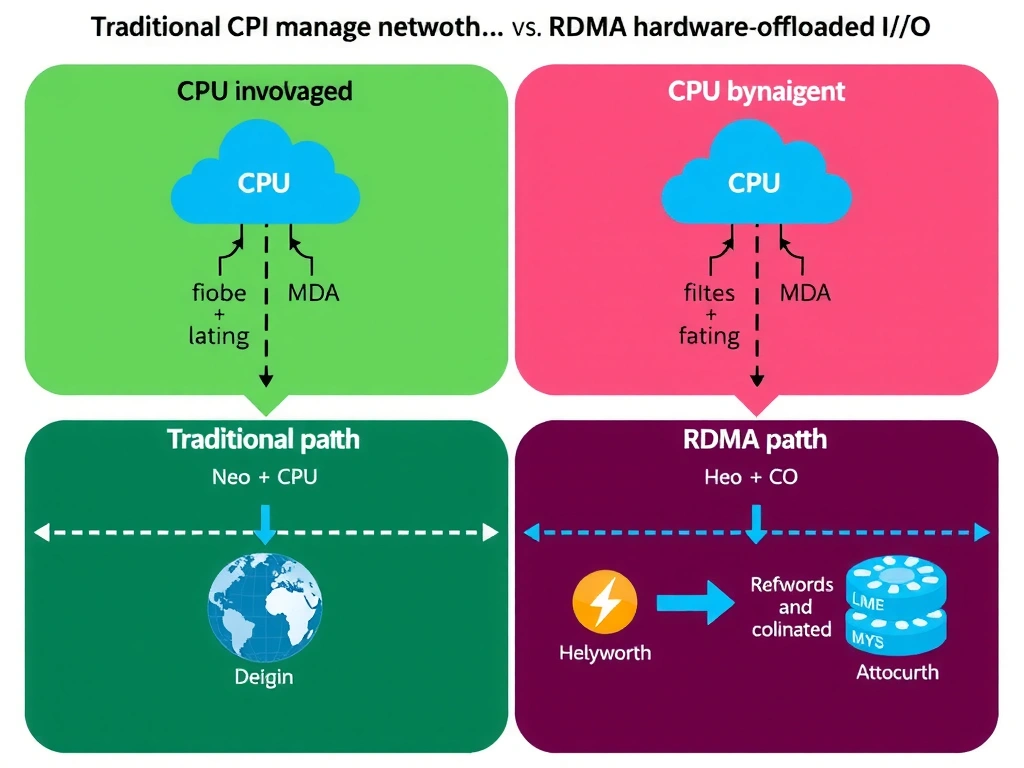
Hardware offloading is the secret sauce. RDMA works because the network adapter (NIC) handles memory transfers directly, bypassing the CPU entirely. Without hardware offloading, RDMA is just a software idea. With it, you get the performance gains.
Full explanation below image
Full Explanation
RDMA is a technique where the network adapter can read/write memory on a remote system without involving the remote CPU. The power comes from hardware offloading — the NIC itself has the intelligence and capability to initiate memory transfers directly. When your GPU wants to send data to another GPU over the network, instead of the CPU having to orchestrate the transfer (read data, package into network packets, send), the NIC does it autonomously. The CPU isn't even involved. This delivers two massive benefits: CPU utilization drops dramatically (the CPU isn't busy managing I/O), and latency plummets (no software overhead, no context switching). Software-defined networking (SDN) is about programmable networks, not RDMA performance. Increased buffer sizes don't directly reduce CPU overhead. NVIDIA Magnum I/O is a software suite for optimizing I/O, but it's not the fundamental enabler of RDMA performance. Hardware offloading in the NIC is what makes RDMA work.