
You're managing an AI cluster and you deploy a job scheduler called Slurm. Team members are asking what Slurm actually does — is it running the training jobs directly? Is it storing data? What's its core role?
Select an answer to reveal the explanation.
Short Explanation and Infographic
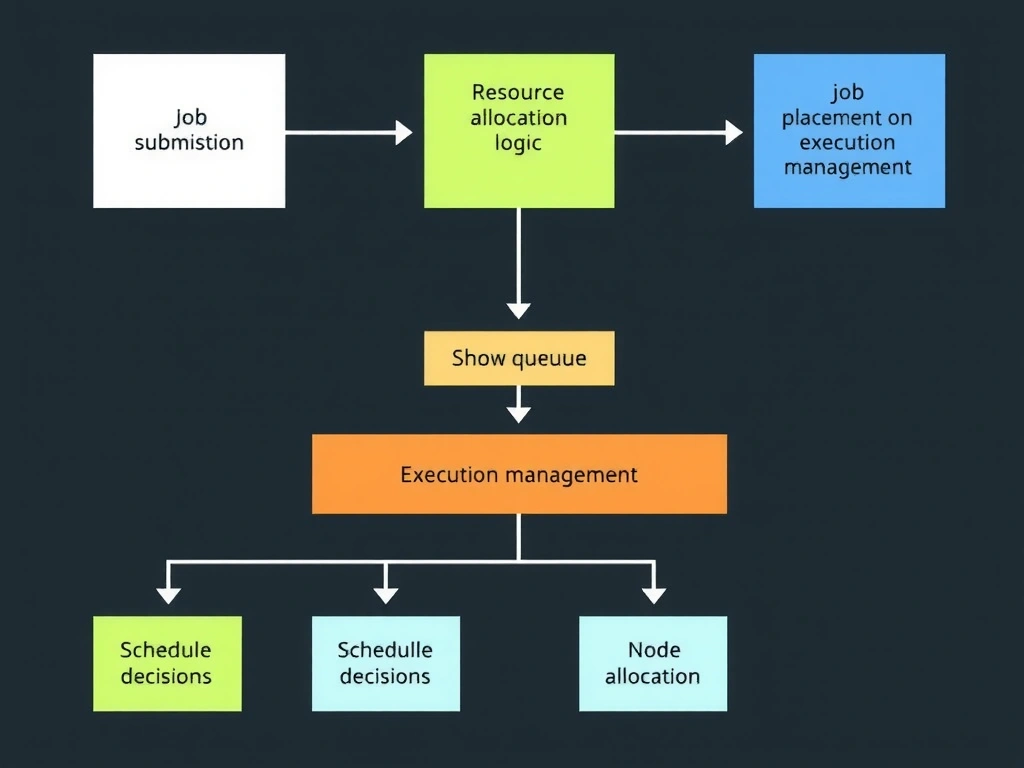
Slurm is a resource manager and job scheduler. You submit jobs to Slurm ("I need 8 GPUs for 4 hours"), and Slurm figures out where to run them based on available resources and policies. It doesn't run jobs directly; it orchestrates where jobs run. It doesn't manage storage or networking.
Full explanation below image
Full Explanation
Slurm (Simple Linux Utility for Resource Management) is a job scheduler and resource manager, particularly popular in HPC (high-performance computing) and AI research clusters. Its job is to take a queue of submitted jobs and allocate cluster resources (CPU, GPU, memory) according to policies, priorities, and availability. When a researcher submits a training job that needs "8 GPUs and 128 GB of RAM for 12 hours," Slurm finds a node (or multiple nodes) with those resources available, reserves them, and launches the job. Slurm also handles: fairness (ensuring different users get fair access), priorities (production jobs run before research experiments), backfilling (filling gaps with small jobs while waiting for large jobs to start), and preemption (stopping low-priority jobs to make room for high-priority ones). Slurm is not a runner of jobs — it doesn't execute model training code. It's an orchestrator and resource allocator. Similarly, it's not a storage system or a network manager. Some other system (Kubernetes, Torque, Condor) might also orchestrate workloads in the same environment, but Slurm's specific domain is resource allocation and job scheduling.