
Your team is evaluating NVIDIA NIMs (NVIDIA Inference Microservices) as a way to deploy your trained models into production. What's the primary selling point — the core value proposition?
Select an answer to reveal the explanation.
Short Explanation and Infographic
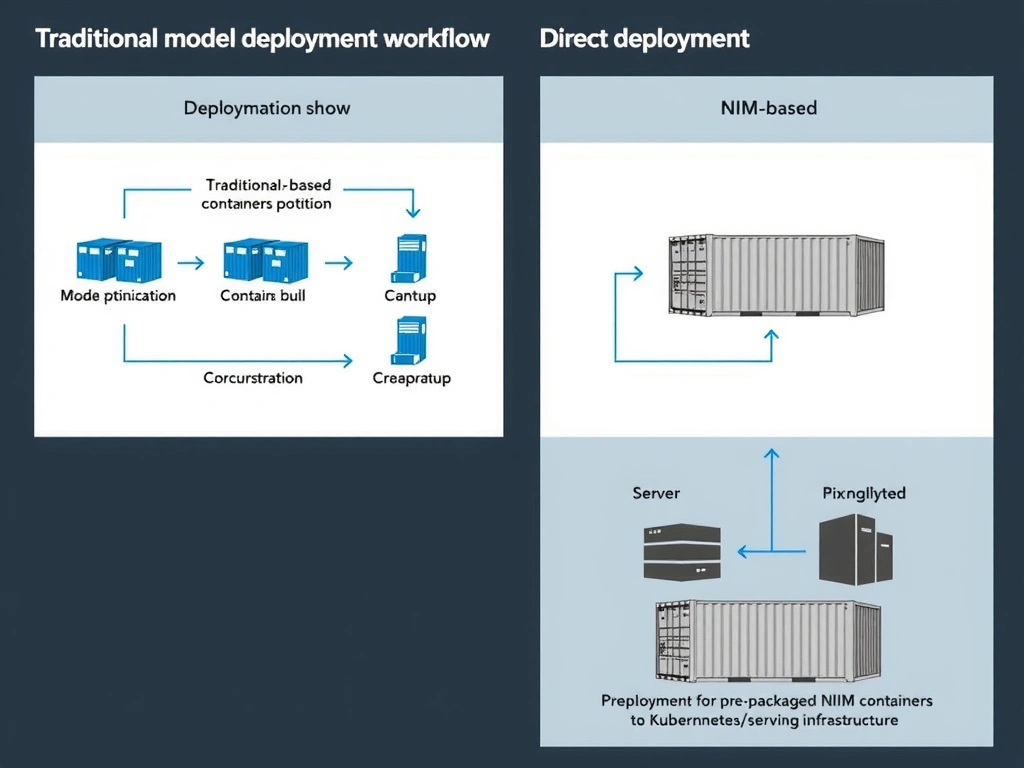
NIMs are all about reducing deployment friction. Instead of managing inference servers, orchestrating containers, and tuning performance yourself, NIMs give you pre-optimized, pre-containerized model deployments that you can spin up quickly. Fast time-to-market, simplified operations.
Full explanation below image
Full Explanation
NVIDIA NIMs are containerized microservices pre-packaged by NVIDIA for common models (Llama, Mistral, etc.). The value isn't in the technology itself — it's in simplification. Normally, deploying a model involves: building a container, optimizing the model using TensorRT, setting up an inference server (Triton, vLLM, etc.), managing scaling and load balancing, configuring monitoring. That's weeks of work for an experienced team and months if you're learning. With NIMs, NVIDIA has already done all that. You get a container that's optimized, tested, and ready to run. You orchestrate it via Kubernetes or Docker, and you're serving predictions. They don't optimize models for non-NVIDIA hardware — they're NVIDIA-first. They don't deploy NVIDIA SDKs generically; they deploy specific models with all SDKs bundled. Community support is nice but secondary to the operational simplification. The core value: reduced time-to-deployment and operational burden.