
Your autonomous vehicle research team needs GPUs for training perception and planning models — huge neural networks that demand both raw compute power and massive memory pools. Which NVIDIA GPU is most suitable for this demanding training workload?
Select an answer to reveal the explanation.
Short Explanation and Infographic
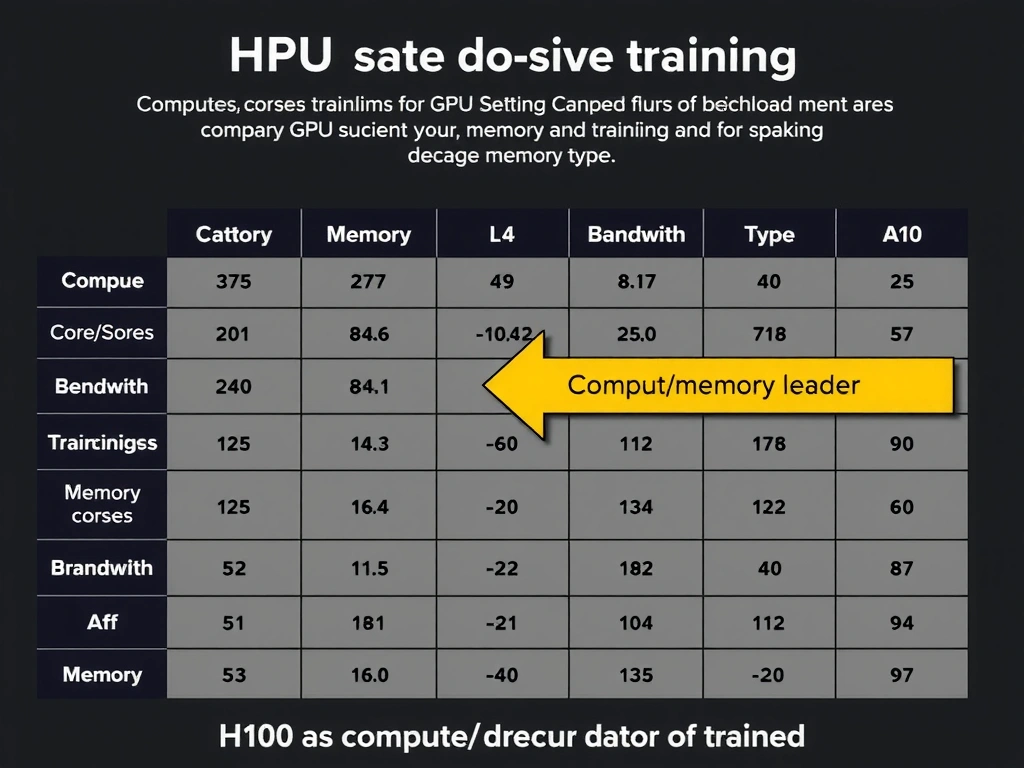
H100 is the compute and memory powerhouse designed for training. L4 is optimized for inference and video encoding. A10 is for VDI and lighter inference. DRIVE Orin is an in-vehicle SoC for edge inference in the car, not training infrastructure.
Full explanation below image
Full Explanation
Choosing the right GPU starts with understanding workload characteristics. H100 is NVIDIA's flagship data center training GPU. It packs 6,912 CUDA cores, 141 Tensor cores, 80 GB of HBM3 memory, and 989 GB/s memory bandwidth. These specs are purpose-built for large model training. When training multi-billion-parameter networks, you need both compute density and memory capacity. H100 excels at both. L4 is a lower-power inference GPU designed for transcoding, serving, and edge inference. It has less memory and fewer cores than H100 — suitable for inference where you're making single predictions, not training on massive datasets. A10 is for virtual desktop infrastructure (VDI), inference, and rendering. It's a hybrid compute-and-graphics GPU but not optimized for training workloads. DRIVE Orin is an embedded system-on-a-chip designed for in-vehicle autonomous driving. It runs perception and planning models on-device (edge inference), not training. For autonomous vehicle R&D, your training happens on data center infrastructure (H100s), and your trained models get deployed to DRIVE Orin for on-vehicle inference. The question tests whether you understand GPU segmentation: training GPUs (H100), inference GPUs (L4, A10), and edge SoCs (DRIVE Orin).