
Your team is building a high-throughput data pipeline for training large AI models, and you need to choose a storage solution that can serve data to multiple GPUs in parallel without becoming a bottleneck. Which of these storage options is specifically designed for that kind of parallel, high-throughput access?
Select an answer to reveal the explanation.
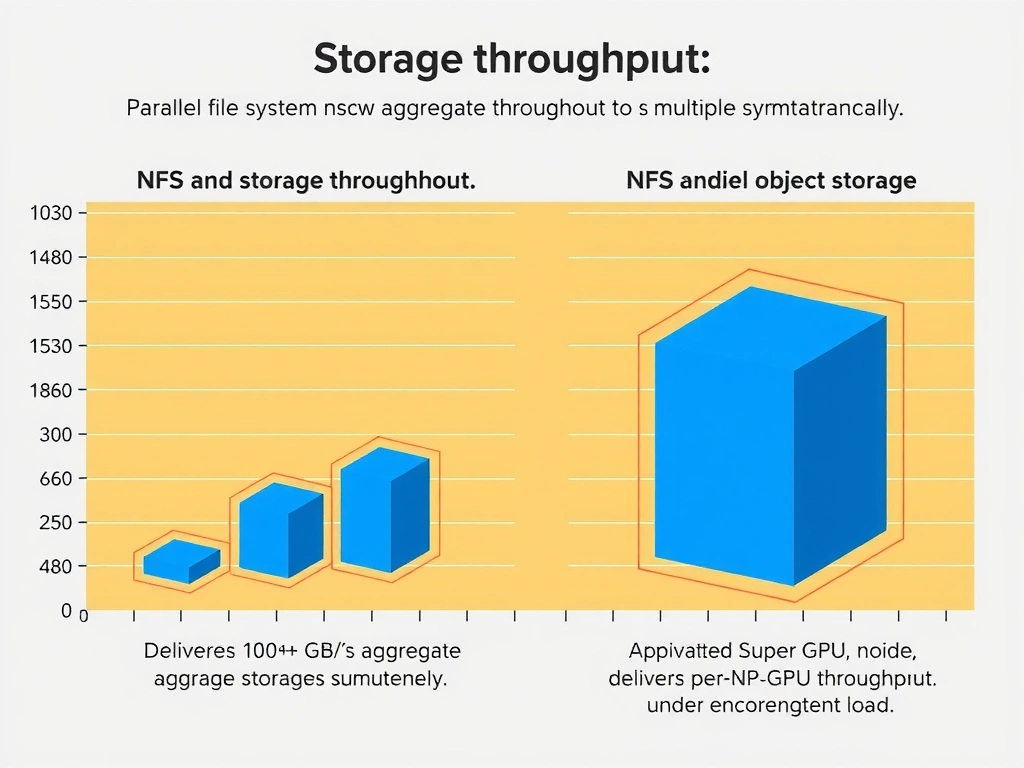
Short Explanation and Infographic
Parallel file systems like Lustre and GPFS are built for exactly this use case: multiple clients reading/writing simultaneously with high throughput and low latency. Object storage has high latency and isn't designed for the tight synchronization training requires. Block storage and NFS don't scale to the parallel I/O demands of large-model training.
Full explanation below image
Full Explanation
When training large models, your GPUs are hungry for data. You might have 8, 16, or 64 GPUs all requesting data simultaneously. A traditional file system like NFS can't keep up — it's designed for sequential or light concurrent access, not this kind of parallel load. Parallel file systems (Lustre, GPFS, BeeGFS, PanFS) are architecturally different. They stripe data across multiple storage servers and allow multiple clients to read/write in parallel. A GPU node doesn't read from one storage server; it reads from multiple servers simultaneously, aggregating bandwidth. This is essential. I've seen teams try to train models on NFS and get 20% GPU utilization because the storage I/O is the bottleneck. Switch to Lustre and utilization jumps to 85%. Object storage (S3, Azure Blob) is great for archival, data lakes, and asynchronous workloads. But it has high latency, immutable writes, and eventual consistency — all bad for real-time training. Block storage (EBS, Azure Disks) is fine for single-client sequential workloads but doesn't provide the parallel I/O scalability needed for training. The question tests whether you understand storage architecture and how it impacts AI workload performance.