
You're designing the network architecture for a large AI cluster, and you're trying to understand the different communication and management networks required. A colleague mentions "four network fabrics" — that sounds like a lot. How many distinct network fabrics do you typically need in a modern AI cluster?
Select an answer to reveal the explanation.
Short Explanation and Infographic
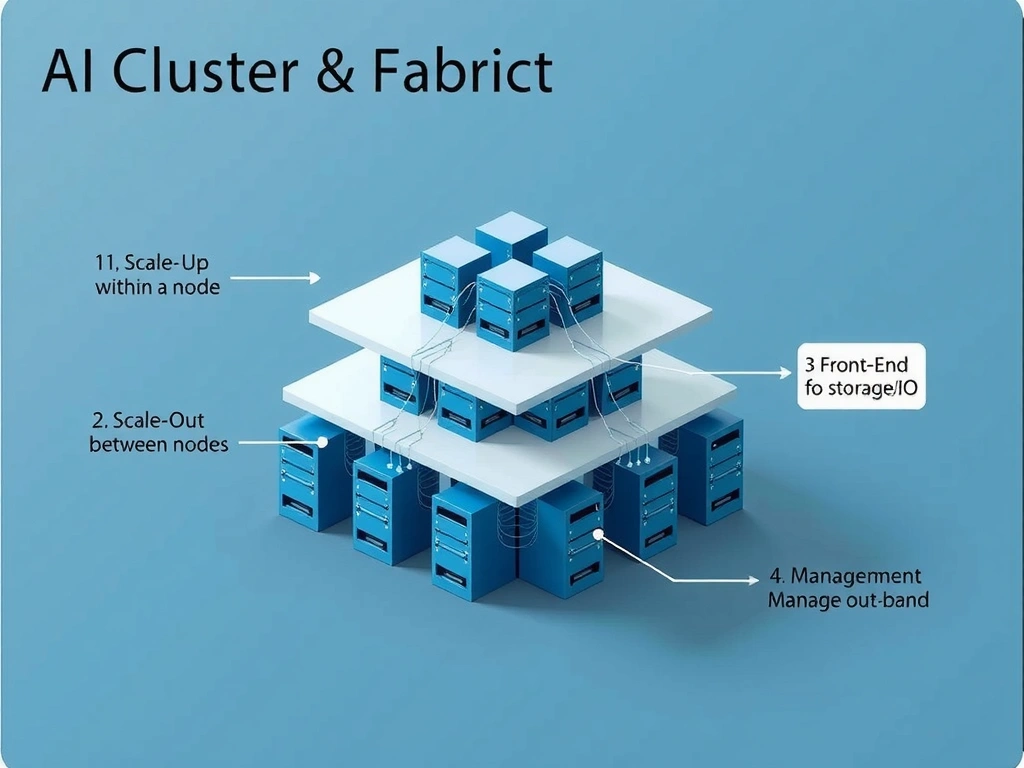
Four network fabrics typically consist of: (1) Scale-Up Fabric (GPU-to-GPU within a node via NVLink/NVSwitch), (2) Scale-Out Fabric (GPU-to-GPU across nodes for distributed training), (3) Front-End Fabric (storage and application I/O), and (4) Management Network (out-of-band administration). That separation of concerns keeps everything running smoothly.
Full explanation below image
Full Explanation
A well-designed AI cluster separates different types of traffic into distinct network fabrics, each optimized for its use case. Scale-Up Fabric connects GPUs within a single node — think NVLink or NVSwitch providing 600 GB/s GPU-to-GPU communication within a DGX system. This is fast, local, and handles intra-node collective operations. Scale-Out Fabric connects GPUs across nodes for distributed training — typically InfiniBand, RoCE, or Ethernet with RDMA. This fabric carries the all-reduce operations, gradient synchronization, and model parameter updates in distributed training. Front-End Fabric is the "normal" network for storage access (NFS, parallel file systems like Lustre), application I/O, and user-facing traffic. It's not optimized for ultra-low-latency like the Scale-Out Fabric, but it's sufficient for storage and I/O. Management Network is the out-of-band channel for administering systems, accessing BMCs (Baseboard Management Controllers), and system logging. It's kept separate so that if your main infrastructure network goes down, you can still access systems for troubleshooting. This separation matters. If you tried to run training all-reduce operations over your storage network, you'd create congestion and slow everything down. By separating fabrics, each can be tuned for its specific workload.