
You're analyzing the deep learning workflow pipeline and trying to understand which phase is the computational bottleneck where distributed, multi-node compute really makes the biggest difference. Should you be parallelizing inference? Data preprocessing? Model training? Which phase benefits most from multi-node architecture?
Select an answer to reveal the explanation.
Short Explanation and Infographic
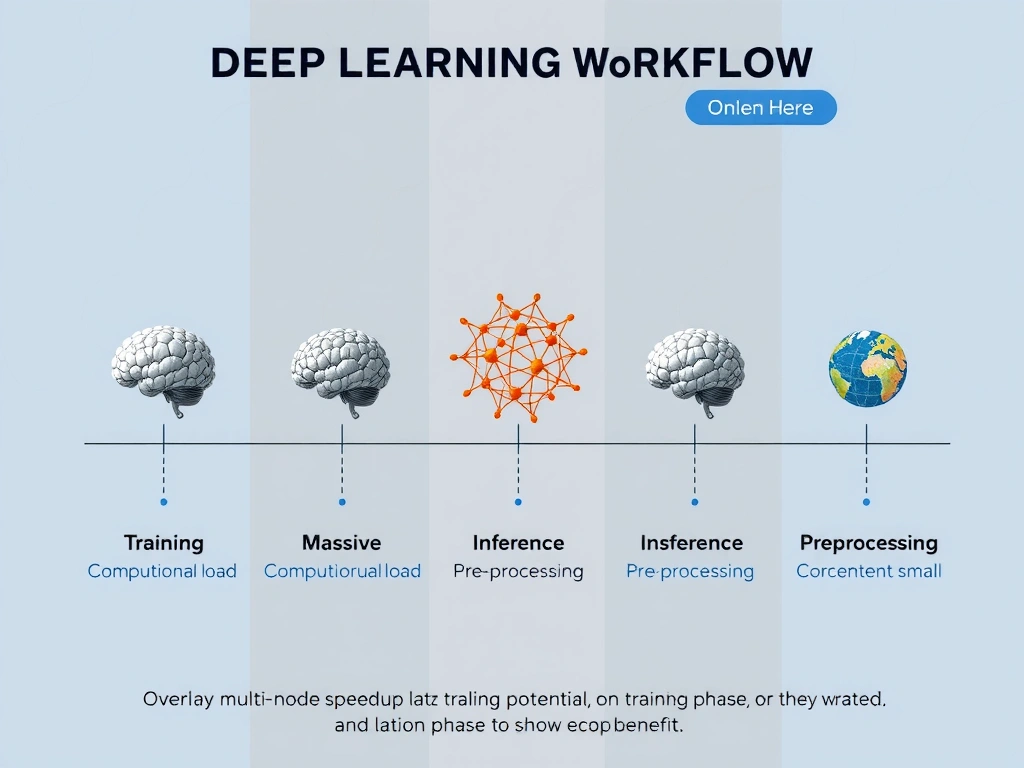
Model training is the compute-intensive phase where you're doing massive matrix multiplications and gradient computations across gigantic datasets. That's where multi-node distributed training shines. Inference is latency-sensitive but less compute-dense per sample. Data preprocessing can be parallelized, but training is the real win.
Full explanation below image
Full Explanation
The deep learning workflow has distinct phases, and each has different computational characteristics. Training is where the magic — and the compute demand — happens. You're iterating through your dataset (sometimes multiple times), computing forward passes, calculating loss, backpropagating gradients, and updating weights. For a large model on a large dataset, this is CPU-years of work. Multi-node distributed training using data parallelism or model parallelism can cut training time from weeks to days. That's why companies invest in multi-node setups for training. Inference, by contrast, is often about latency and throughput. You have a trained model and you want to make predictions. This is computationally less intense per sample (one forward pass, no backprop). Multi-node inference is useful for high-throughput serving, but the per-sample latency doesn't improve much by distributing. Data preprocessing and augmentation can be parallelized, but it's often I/O-bound rather than compute-bound. And it's a one-time cost compared to training. Deployment is about serving the model in production, not about training. The question tests whether you understand where the computational ROI of multi-node setups actually comes from: training.