
You're migrating petabytes of training data from your on-premises storage to a cloud object storage service, and your compliance team is asking how you'll ensure no data corruption occurred during transit. Which approach actually verifies end-to-end data integrity?
Select an answer to reveal the explanation.
Short Explanation and Infographic
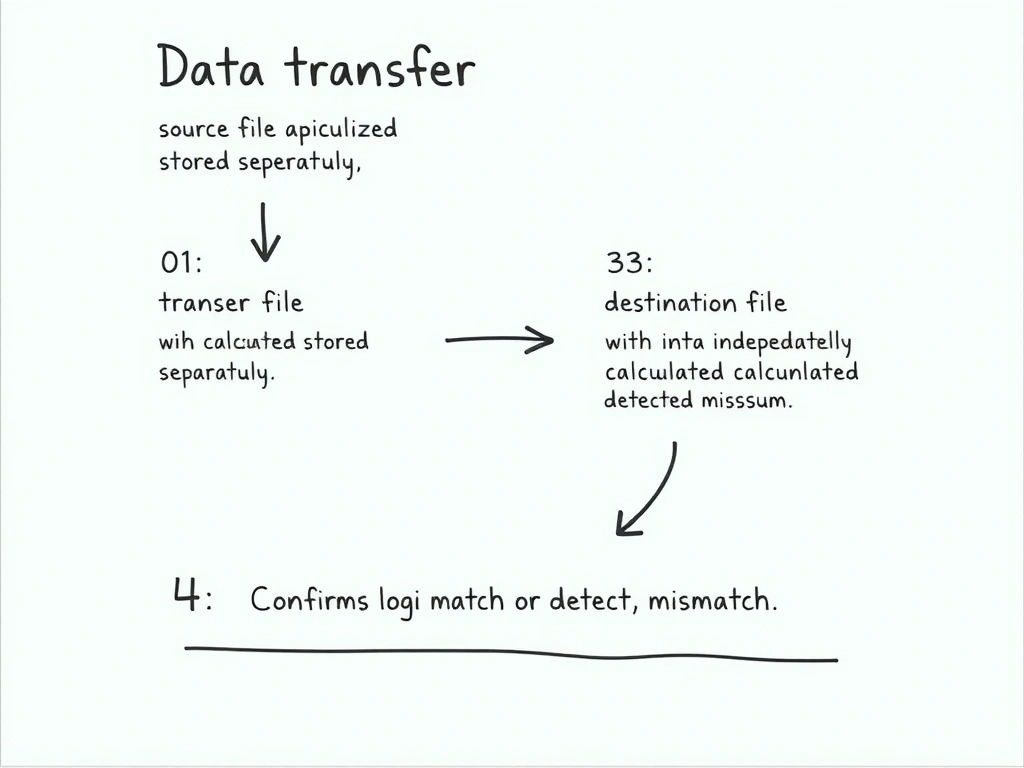
Checksums before and after are the gold standard. Calculate a checksum on the source, transfer the data, calculate the checksum on the destination, compare. If they match, your data is intact. Cloud durability is nice (it means your data exists in multiple places), but it doesn't detect corruption during transit. Incremental backups don't verify integrity. Post-only verification misses corruption that happened during the transfer and then was compounded.
Full explanation below image
Full Explanation
End-to-end data integrity verification requires checksums on both sides of the transfer. Before you send data, calculate a checksum (MD5, SHA-256, whatever) of the source file and store it. Transfer the data to the cloud. Once transfer completes, calculate the same checksum on the destination file. Compare the two. If they match, the data arrived intact. If they don't, something corrupted the data in transit. This is the only way to guarantee integrity. Now, cloud providers offer durability guarantees — they replicate your data across multiple drives and data centers. But durability doesn't detect corruption; it just means if a disk fails, you can recover from another copy. If data gets corrupted during transit (bit flip, network error, etc.), durability doesn't help. Incremental backups are about efficiency (only backing up changed blocks), not integrity verification. And post-only checksum verification (checking after the transfer completes) is better than nothing, but it's not bulletproof — if the data got corrupted and then stored with the bad checksum, you're hosed. Best practice: checksum source, transfer, checksum destination, compare.