
You're reviewing a presentation on recent AI adoption trends, and it highlights two key technological enablers that made AI practical and accessible for enterprises. Which two of these have actually been critical for making AI feasible at scale?
Select all correct answers, then click Submit.
Short Explanation and Infographic
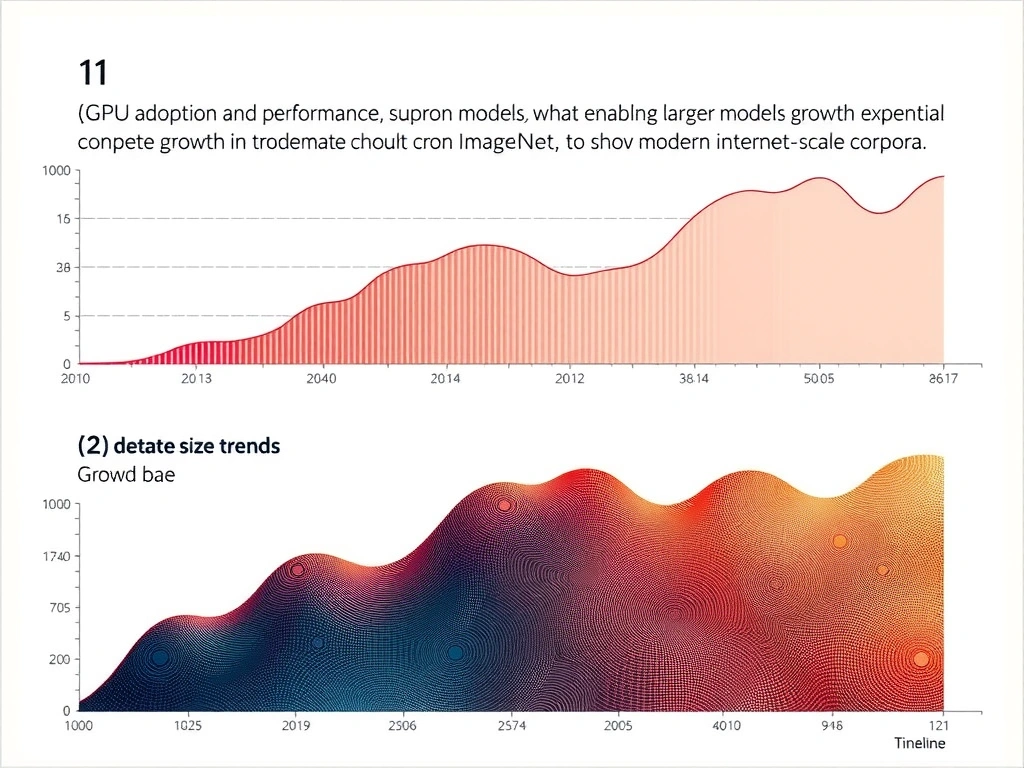
GPUs provide computational firepower, and Big Data provides the fuel for models to learn from. Rule-based systems are legacy; Moore's Law slowing down didn't drive AI adoption. The real drivers are GPUs and data.
Full explanation below image
Full Explanation
The enabling factors for modern AI are GPU hardware and data. GPUs are non-negotiable. A modern LLM trained on CPUs would take centuries to train. GPUs parallelize the math efficiently. Big Data — the ability to collect, store, and process massive datasets — is equally essential. Deep learning is fundamentally data-driven; you can't train complex models without diverse, large-scale datasets. ImageNet (1 million images) was transformative in 2012. Today's LLMs see hundreds of billions of tokens. Rule-based machine learning was the old paradigm — you hand-code rules, the system follows them. That never scaled to the complexity of real-world problems. Moore's Law slowing down (transistor shrinking hitting physical limits) might encourage more efficient algorithms, but it's not a driver of AI adoption. If anything, the slowdown makes GPUs and specialized accelerators even more important. The question tests whether you can distinguish genuine technological enablers from historical footnotes.