
Your organization is designing a modern AI data center, and someone asks about DPUs — Data Processing Units. They're not the main compute chips; they're separate. What's the strategic point of deploying DPUs alongside your main compute infrastructure?
Select an answer to reveal the explanation.
Short Explanation and Infographic
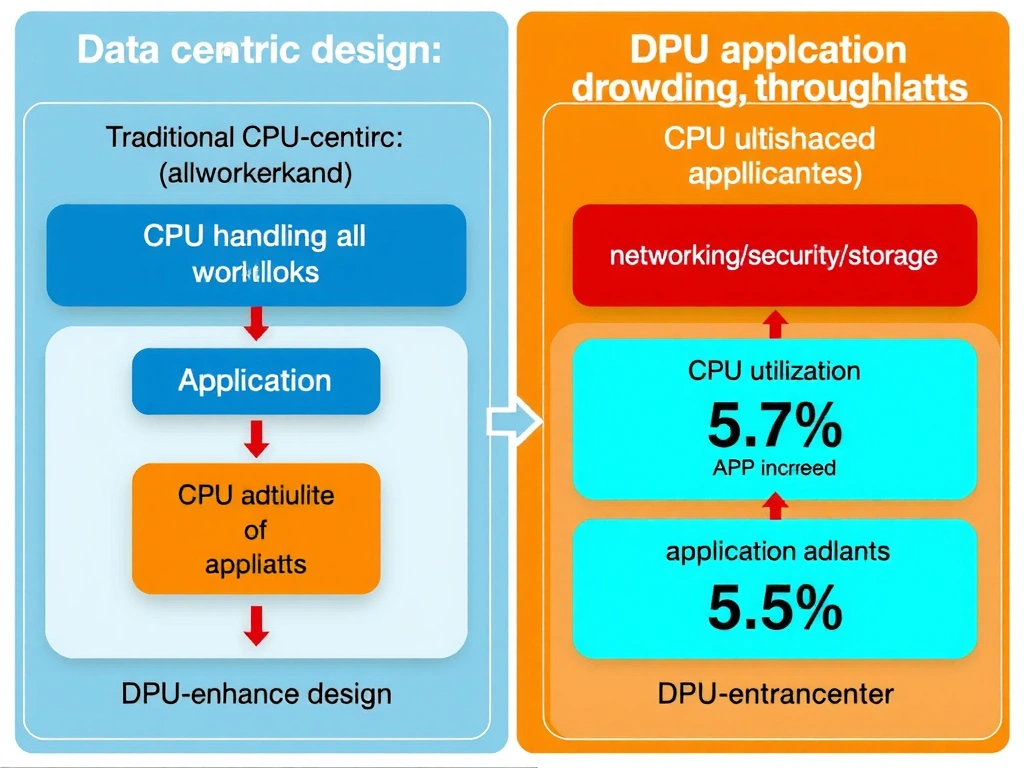
DPUs are smart network and infrastructure processors. Instead of your main CPU handling networking, security, and storage I/O, the DPU does it. This frees your CPU to focus on what it's good at — running your AI applications. It's like hiring a specialized worker so your core team can focus on the main job.
Full explanation below image
Full Explanation
A Data Processing Unit (DPU) is an emerging architecture that reflects a fundamental shift in data center design. Traditionally, the CPU handles everything: application logic, network packet processing, security enforcement, storage I/O management. In high-performance data centers, this is inefficient. The CPU spends cycles on infrastructure tasks when it could be running your AI workloads. The DPU is a specialized processor that handles infrastructure workloads — it manages networking (packet routing, switching, load balancing), security (firewall, encryption, intrusion detection), and storage processing. By offloading these tasks to the DPU, your main CPU is free to run applications. This improves both performance (dedicated hardware is more efficient) and security (isolated processing plane for sensitive infrastructure tasks). Think about it: when you're running distributed deep learning across GPUs, every CPU cycle matters. If the CPU is busy managing network packets or disk I/O, your training job slows down. DPUs solve that. Now, DPUs are not about managing physical infrastructure like power and cooling — that's still done by traditional management networks. They're not purely for backup and disaster recovery. They're infrastructure acceleration and security isolation.