
You're reading a paper on recent breakthroughs in deep learning, and the authors credit three key factors that made their results possible. You want to understand what has actually driven the deep learning revolution over the past decade. Which of these are actually critical factors, not just noise?
Select all correct answers, then click Submit.
Short Explanation and Infographic
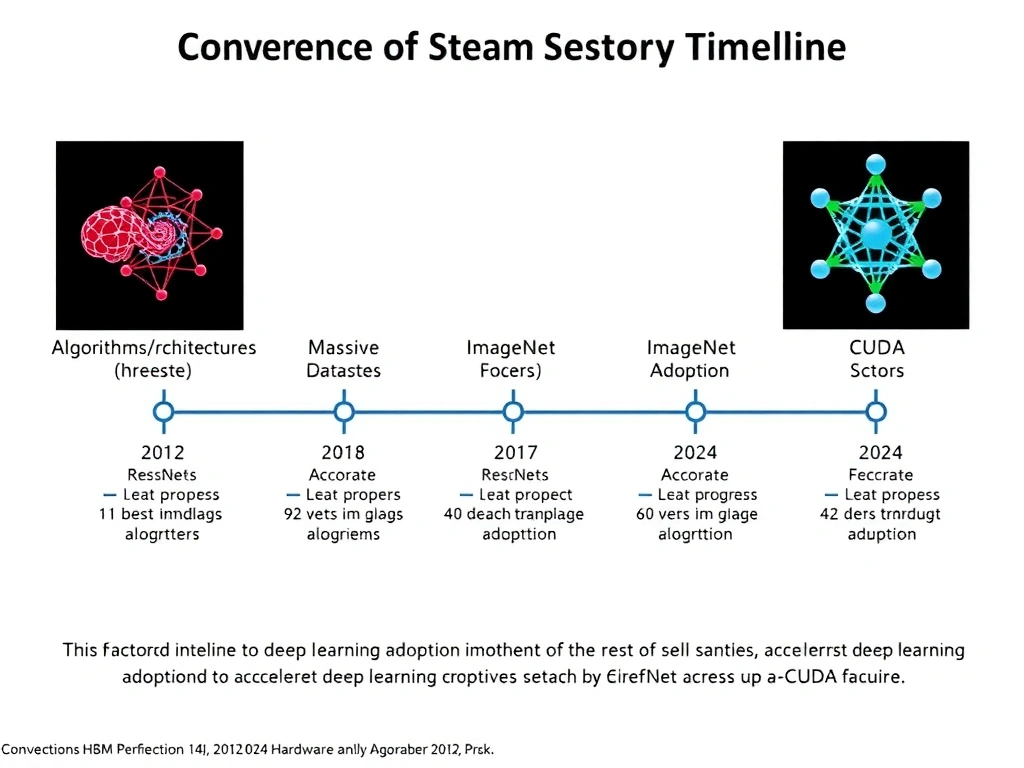
The real drivers are: better algorithms and architectures (more sophisticated training techniques, transformer models, etc.), massive datasets (you can't train deep models without data), and GPU hardware (without it, training is glacially slow). Traditional statistical methods didn't decrease — they're still used. High-speed internet is nice but not fundamental to deep learning breakthroughs.
Full explanation below image
Full Explanation
The deep learning revolution required three essential ingredients to converge. First: algorithms and architectures. Backpropagation, ReLU activations, batch normalization, attention mechanisms, transformers — these innovations let us train deeper, more sophisticated models that actually learn useful representations. Second: data. Deep learning is fundamentally data-hungry. ImageNet with 1 million labeled images was transformative; today's large language models are trained on hundreds of billions of tokens. You cannot do deep learning at scale without massive, diverse datasets. Third: hardware. Deep learning computations are massively parallel. GPUs, with thousands of cores executing simple operations in parallel, are perfect for this. Without the GPU revolution and specialized accelerators (TPUs, H100s), training a modern large language model would take decades. Now, traditional statistical methods haven't decreased in popularity — they're still used for many problems. They didn't lose relevance; they just became one tool among many. And high-speed internet? It's helpful for distributed training and data delivery, but it's not a fundamental driver. I remember when people thought internet bandwidth was the bottleneck; turns out computation and data availability were far more constraining.