
You're comparing network fabrics for a high-performance AI infrastructure deployment, and you're debating between InfiniBand and standard Ethernet for your inter-GPU communication. A colleague says Ethernet is catching up, but another says InfiniBand is still the gold standard for latency-sensitive workloads. What's the primary architectural advantage of InfiniBand over Ethernet in this context?
Select an answer to reveal the explanation.
Short Explanation and Infographic
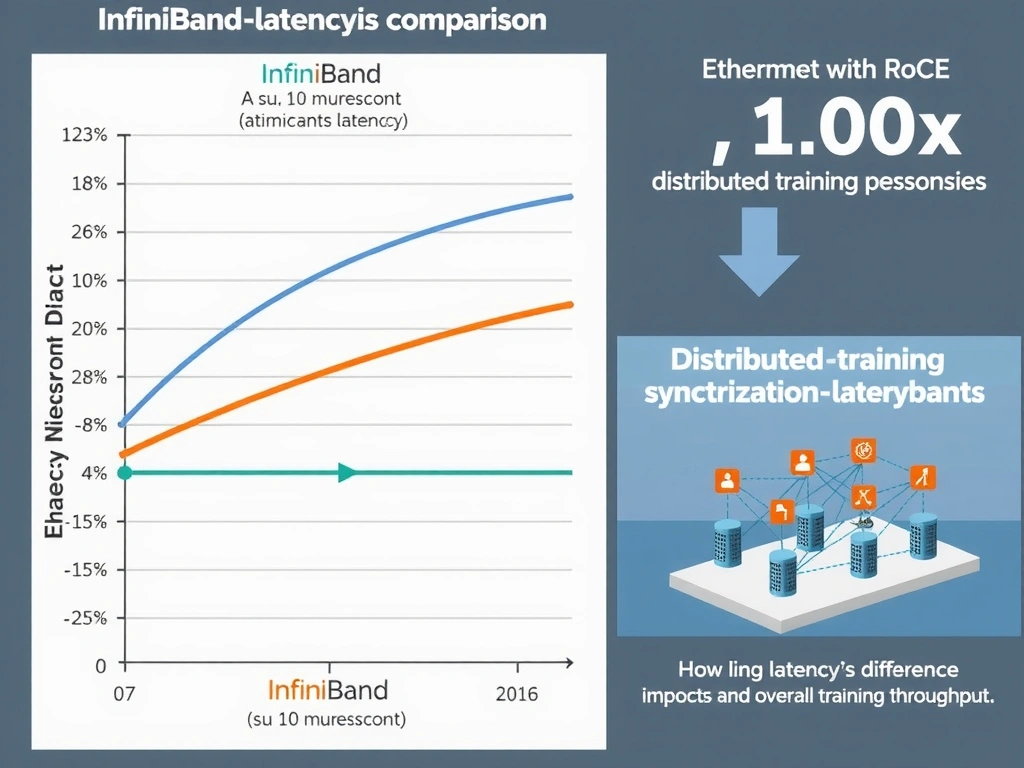
InfiniBand's architecture is optimized for latency. That's the gold standard in distributed training: you need GPU-to-GPU communication to be fast and predictable. While Ethernet standards are catching up in bandwidth and RDMA support (RoCE — RDMA over Converged Ethernet), InfiniBand still generally minimizes latency better. For latency-sensitive workloads like distributed deep learning, that matters.
Full explanation below image
Full Explanation
InfiniBand's fundamental design philosophy is low latency. Every architectural decision — from the physical layer up through the protocol stack — prioritizes minimizing the time it takes to send a message from one GPU to another. When you're training a model across eight H100 GPUs using data-parallel training, every millisecond of communication overhead compounds. Multiply that by thousands of training iterations, and you're looking at significant training time impact. InfiniBand delivers latency in the single-digit microsecond range, consistently and predictably. Now, Ethernet has made serious progress. RoCE (RDMA over Converged Ethernet) brings RDMA capabilities to Ethernet, so you get better CPU offloading than with traditional Ethernet. Modern 400 Gbps Ethernet delivers impressive bandwidth. But latency? Ethernet typically runs 10–100x higher latency than InfiniBand. For batch inference, that extra latency might be acceptable. For distributed training synchronization, it's painful. The question is testing whether you understand the performance tradeoff. InfiniBand isn't universally "better" — it's expensive and specialized. But for latency-sensitive workloads, it's the right choice. Regarding security and exclusivity of RDMA: both are myths. Ethernet with RoCE supports RDMA, and InfiniBand's security is comparable to Ethernet.