
You're the infrastructure lead at a growing AI shop, and you've just deployed a cluster of DGX systems spread across three data center racks. The team is asking for dashboards and health monitoring across all the GPUs — not just one-off command-line checks. You need a tool that's built to scale across dozens of GPUs, collecting telemetry, detecting anomalies, and giving your ops team visibility. Which NVIDIA tool are you reaching for?
Select an answer to reveal the explanation.
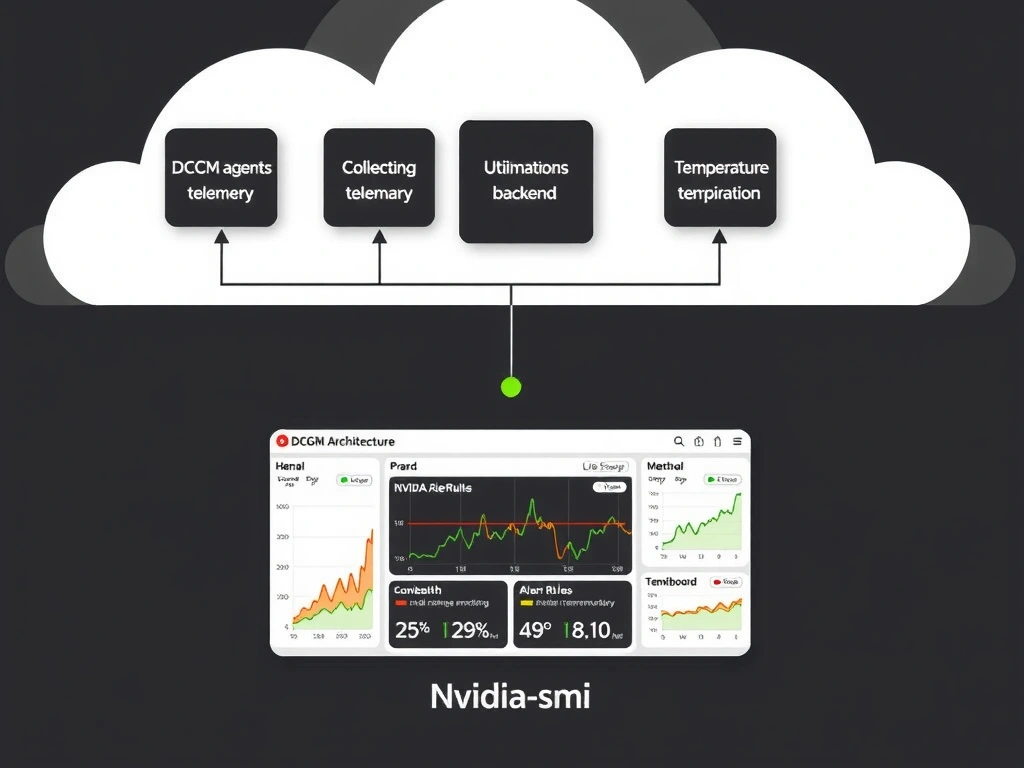
Short Explanation and Infographic
DCGM is the enterprise-grade monitoring and management platform for GPU fleets. nvidia-smi is fine for a quick check on a single machine, but when you've got dozens of GPUs spread across multiple nodes, you need DCGM's central visibility, health monitoring, metrics collection, and alerting. CUDA Toolkit is for development, and NetQ is for network telemetry.
Full explanation below image
Full Explanation
DCGM is NVIDIA's purpose-built tool for managing GPU infrastructure at scale. Think of it like Prometheus or a monitoring agent, but it's GPU-obsessed. It runs on each GPU node and collects continuous telemetry: GPU utilization, memory usage, temperature, power consumption, clock throttling events, XID errors. Then you can centralize that data in a monitoring stack (Prometheus, Grafana, etc.) and build dashboards. When a GPU gets hot and starts throttling, DCGM alerts you. When GPU memory error bubbles up, DCGM catches it and logs it. When you're trying to figure out why your training throughput is lower than expected, DCGM's detailed metrics often show you the culprit — maybe the GPU clock is stuck at a lower frequency due to thermal constraints. Here's where nvidia-smi falls short: it's a point-in-time query tool. You SSH in, run it, see GPU 0 at 95% utilization, and then what? You have no history. Was it at 95% five minutes ago? Did it spike to 100% and drop? You don't know. DCGM continuously streams that telemetry so you can see the full picture over time. In large deployments, DCGM is non-negotiable.