
You're managing a resource-constrained AI cluster where GPUs are expensive and always in high demand. Multiple teams are queuing up jobs — training, inference, hyperparameter tuning — and they all want to run NOW. Without any orchestration, your cluster would devolve into chaos: some jobs starve while others hog resources. What's the primary benefit of deploying a job scheduler in this environment?
Select an answer to reveal the explanation.
Short Explanation and Infographic
A job scheduler is your sanity check. It doesn't create GPUs out of thin air, and it's definitely not "run everything at once." What it does do is make smart allocation decisions: prioritizing critical jobs, packing workloads efficiently, and ensuring fair resource distribution based on policies you define. This is what keeps your cluster from turning into a parking lot of waiting jobs.
Full explanation below image
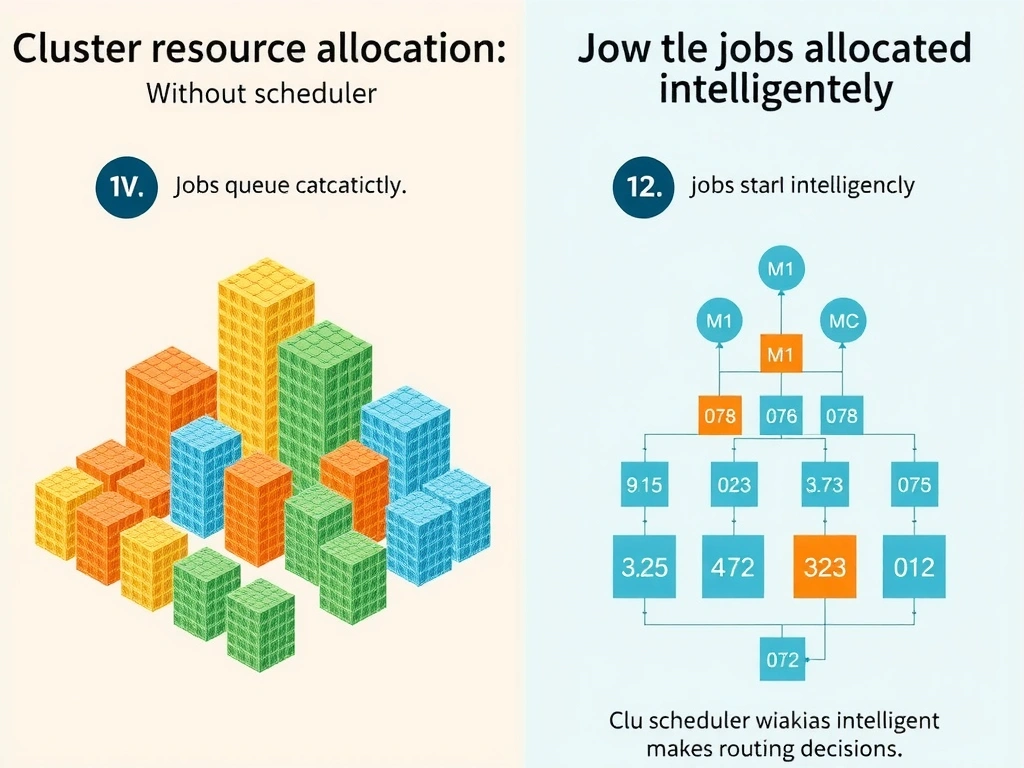
Full Explanation
In any resource-constrained environment, a job scheduler is essential. It acts as a traffic cop for your cluster, making intelligent allocation decisions based on job requirements, priorities, dependencies, and available resources. When multiple teams submit jobs, the scheduler doesn't just say "first person to submit wins." Instead, it considers factors like: Is this a production inference job or a research experiment? Does this job need eight GPUs or just one? Are there resource reservations already in place? What's the priority level? By implementing policies (QoS, priority levels, fairness mechanisms), a scheduler ensures critical workloads get timely access while still allowing other work to progress. This is fundamentally different from first-come-first-served (FCFS), which often leads to starvation and poor utilization. A scheduler also enables preemption — if a high-priority job arrives and resources are tied up by a low-priority experiment, the scheduler can pause the experiment, run the high-priority job, then resume. That's operational maturity. Without a scheduler, you're managing job contention manually — asking people to wait, making judgment calls, dealing with angry data scientists. With a scheduler, it's automated and fair according to your policies.