
You're troubleshooting a data pipeline for a deep learning training job, and the data transfer from your storage system to the GPUs is slower than expected. Your CPU is pegged at 100% utilization during the transfer, which is a dead giveaway that the CPU is becoming the bottleneck. You want a technology that lets the GPU grab data directly from storage without putting that CPU to work. Which of these is the right tool for the job?
Select an answer to reveal the explanation.
Short Explanation and Infographic
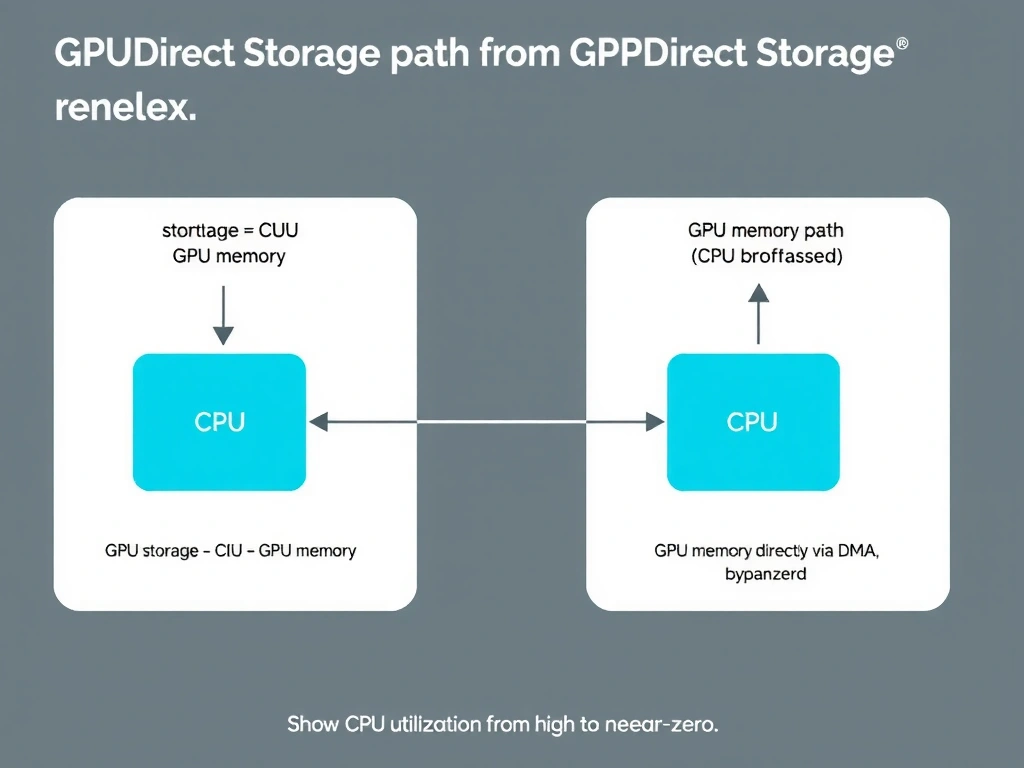
GPUDirect Storage is your hero here. It's NVIDIA's answer to the CPU bottleneck problem — it lets the GPU fetch data straight from storage via direct memory access (DMA), completely bypassing the CPU. InfiniBand handles server-to-server networking, NVLink connects GPUs within a single node, and P2P handles GPU-to-GPU chatter. But GPUDirect Storage? That's specifically for the GPU-to-storage handshake.
Full explanation below image
Full Explanation
GPUDirect Storage unlocks huge performance gains when training on terabytes of data. Moving that data from disk to GPU memory becomes a critical bottleneck. Traditionally, the CPU reads from storage, stages the data in CPU memory, then copies it to GPU memory — three hops and it kills CPU utilization. Your training GPU sits idle waiting. GPUDirect Storage flips the script: the GPU issues a direct memory access (DMA) request to the storage system, and the data flows straight from disk to GPU memory. The CPU is completely out of the picture. In production, this can cut your data-loading time by 50–70%, especially for workloads with large sequential reads. InfiniBand connects multiple servers with low latency but isn't GPU-to-storage. NVLink connects GPUs within the same system. GPUDirect P2P handles GPU-to-GPU communication. None solve the CPU-bottleneck-on-storage-access problem. I've seen teams see CPU at 100% and storage throughput not living up to specs, not realizing GPUDirect Storage is sitting there waiting to be enabled.