
An AI engineering team has trained a deep learning model using PyTorch and wants to deploy it to a production environment. To meet their latency service level agreements (SLAs), they need to optimize the model's graph structure, merge redundant layers, and calibrate weights to FP16 precision. Which component of the NVIDIA software stack should they use to optimize this model for inference?
Select an answer to reveal the explanation.
Short Explanation
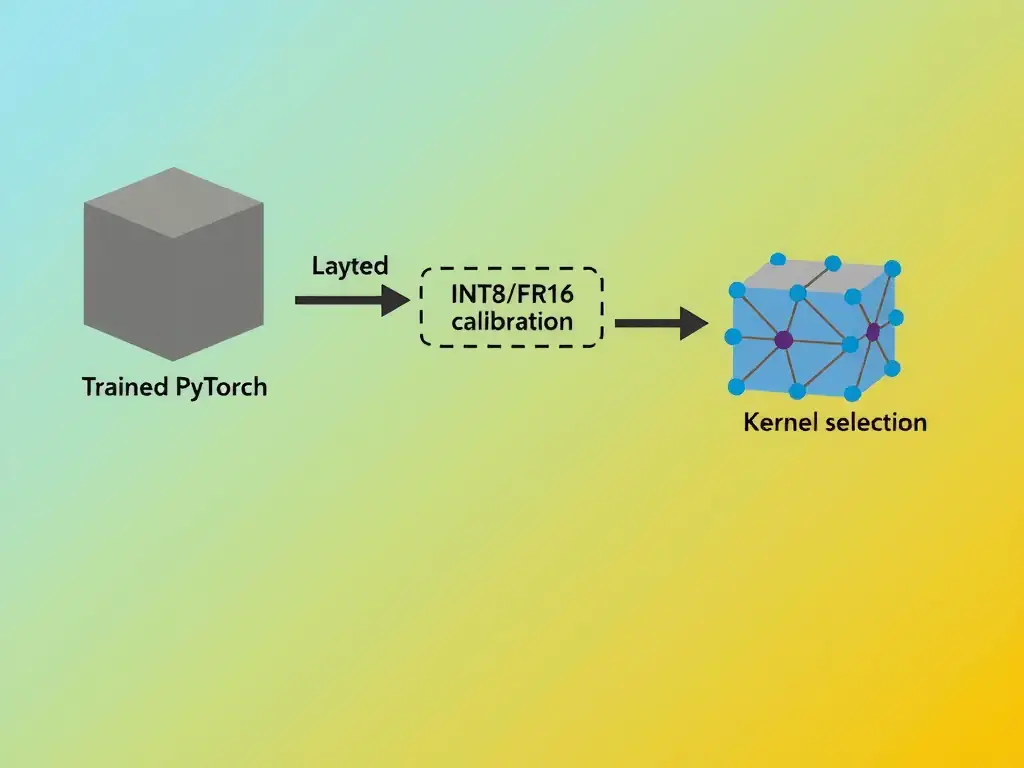
When your model's latency is too high, you don't rewrite it; you run it through NVIDIA TensorRT. It optimizes the trained model by fusing layers, removing unused operations, and calibrating weights to FP16 or INT8. Triton serves models, but TensorRT makes the model itself run faster.
Full Explanation
Deploying deep learning models in production requires minimizing latency and maximizing throughput. NVIDIA TensorRT is a high-performance deep learning inference optimizer and runtime library designed specifically for this purpose. TensorRT takes a trained model from frameworks like PyTorch or TensorFlow (often via the ONNX format) and performs several key optimizations: 1. Layer and Tensor Fusion: Combines adjacent nodes in the model graph (e.g., merging a convolution, bias, and ReLU activation into a single kernel execution) to reduce memory transfers and kernel launch overhead. 2. Precision Calibration: Converts model weights and activations to lower-precision representations (such as FP16 or INT8) while maintaining accuracy, which accelerates computation and reduces memory bandwidth requirements. 3. Kernel Auto-Tuning: Selects the best-performing CUDA kernels for the target GPU architecture. 4. Dynamic Memory Management: Optimizes memory footprint and reuse during execution. Let's look at why the other options are wrong: The NVIDIA Triton Inference Server option is an open-source inference serving software that allows teams to deploy and scale AI models from any framework in production. Triton uses TensorRT-optimized engines, but it does not perform the graph optimizations or precision calibration itself. The NVIDIA cuDNN option is a low-level library of GPU-accelerated primitives for deep neural networks. While TensorRT calls cuDNN under the hood, cuDNN is not an end-to-end model compiler or graph optimizer. The NVIDIA CUDA Toolkit option is the foundational parallel computing platform and programming model. It is too low-level and does not provide built-in deep learning model compilation or graph optimization workflows.