
You are planning a series of large-scale batch hyperparameter tuning jobs for a deep learning model using cloud-hosted NVIDIA GPUs. The jobs are expected to run for several days, but they can be paused and resumed from checkpoints without issue. Which cloud deployment strategy will provide the most significant cost savings without degrading model training performance?
Select an answer to reveal the explanation.
Short Explanation
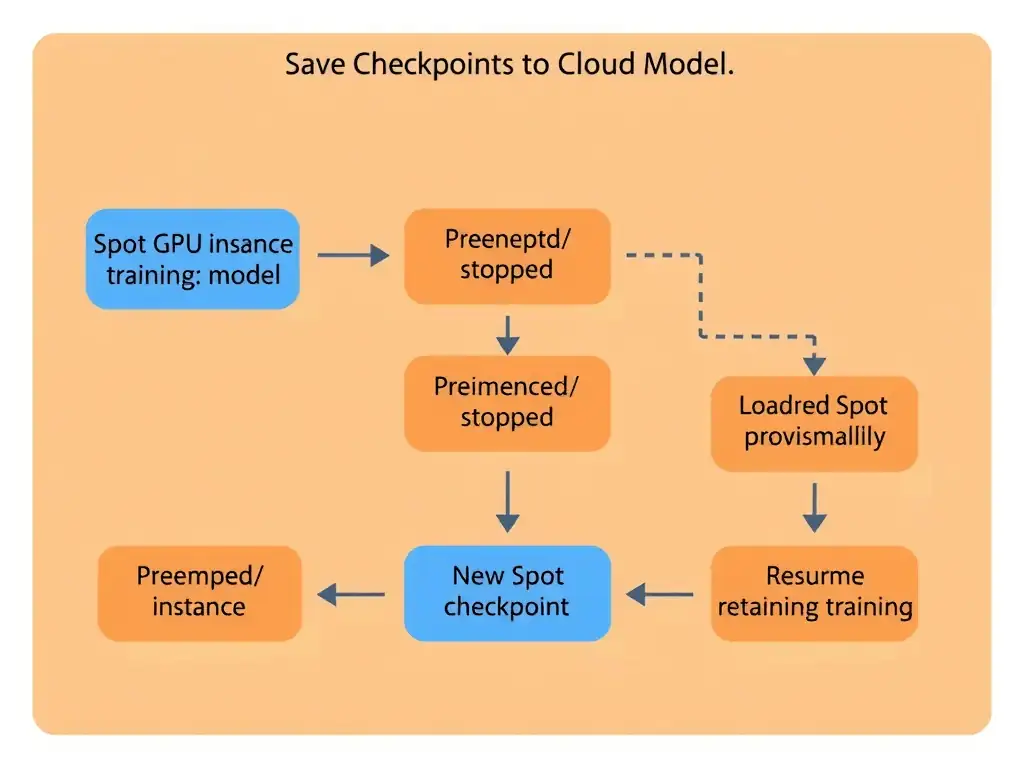
When your GPU training bill starts looking like a phone number, use GPU-enabled Spot (preemptible) instances with automated checkpoint recovery. You get the same GPU speed at a steep discount, and if the cloud provider reclaims a node, your automation resumes from the last checkpoint. That's how you slash costs without slowing training.
Full Explanation
Cloud providers offer various pricing models for virtual machine instances, including GPU-enabled instances. The two most common are On-Demand instances, which provide guaranteed availability at a flat rate, and Spot or Preemptible instances, which use excess capacity and can be discounted heavily, often up to 60 to 90 percent, but may be reclaimed with short notice. For deep learning workloads that are interruption-tolerant, such as batch processing, hyperparameter tuning, or long training runs that use regular model checkpointing, Spot instances offer a highly cost-efficient solution. Because deep learning frameworks can save training state, including model weights and optimizer state, to persistent storage, if a cloud provider preempts a Spot instance, the orchestration system, such as Kubernetes with Spot node groups, can automatically provision a new instance and resume training from the latest checkpoint. This achieves maximum hardware performance at a fraction of the cost of On-Demand instances. The approach of running all tuning jobs on a single, low-cost CPU instance using software-based GPU emulation is technically possible but extremely slow. Deep learning workloads require the parallel processing power of GPUs, and software-based emulation on a CPU could take weeks or months, failing the performance requirement. The approach of provisioning dedicated, on-demand GPU instances and running them continuously at full capacity offers maximum stability but is the most expensive deployment strategy. The approach of restricting training runs to off-peak hours on on-demand instances does not save money because cloud providers generally charge flat rates for on-demand instances, meaning hourly rates do not decrease at night. It also artificially delays project completion.