
An infrastructure architect is designing two distinct hardware clusters: one for training a new large language model (LLM), and another for serving the model to millions of active users. Which statement accurately highlights a core operational difference in the compute and storage needs of training versus inference?
Select an answer to reveal the explanation.
Short Explanation
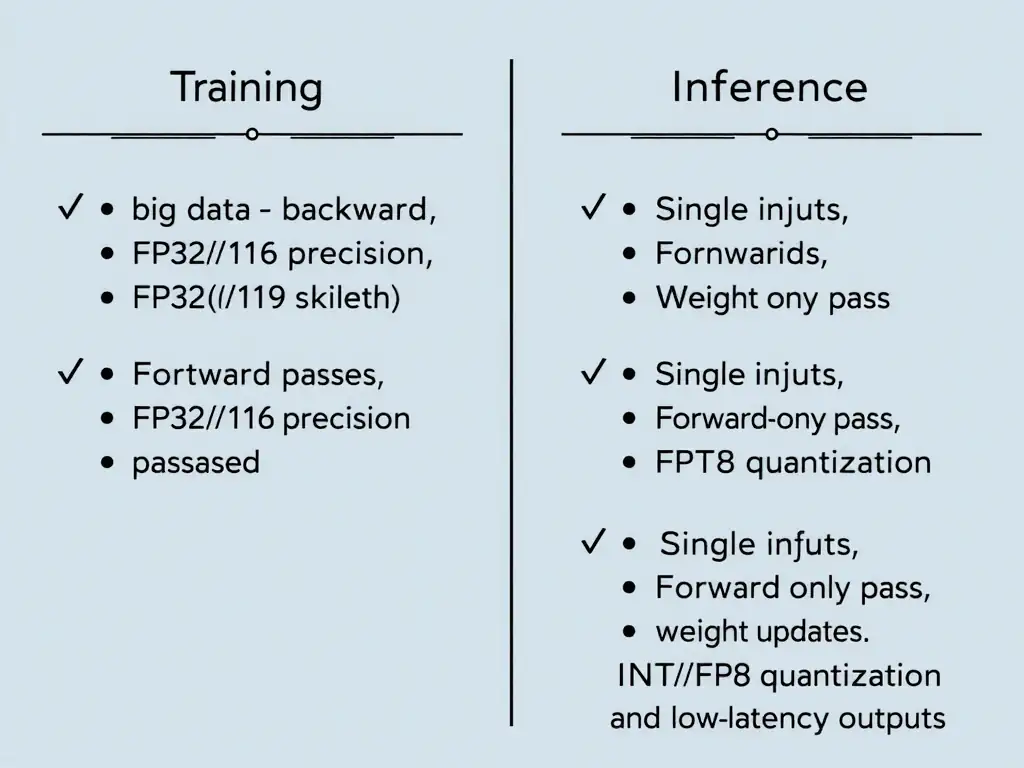
Pay close attention, because this classic exam concept bites people in the real world too. Training and inference aren't the same beast: you need high precision like FP32/FP16 to update gradients and massive continuous data input/output throughput to ingest raw training datasets, while inference is optimized for low latency and often uses lower precision.
Full Explanation
The lifecycle of a model is split into two phases—training and inference—each placing distinct demands on hardware infrastructure. Training is the process of building the model's parameters (weights and biases) from scratch using a dataset. This process involves a forward pass to calculate predictions, a loss calculation, and a backward pass (backpropagation) to calculate weight gradients. To prevent rounding errors from destabilizing the gradient descent optimization, training requires high floating-point precision (typically FP32, TF32, or mixed FP16). Additionally, the training cluster must ingest enormous datasets continuously, demanding ultra-high-throughput storage systems (like NVMe-over-Fabrics) and high-speed network fabrics. In contrast, inference is the execution of a pre-trained model on new, unseen data to generate predictions. Because the weights are fixed during inference, the mathematical operations are forward-only and do not require backpropagation. This allows inference engines to utilize lower-precision numeric formats (such as INT8 or FP8) through a process called quantization, which reduces memory footprint and accelerates throughput. Furthermore, inference operates on small batch sizes (often batch size 1 for real-time applications) to minimize latency, meaning it does not require the massive sequential data ingest capacity necessary for training. Exam caveat: training is high-precision and high input/output throughput; inference is low-latency, lower-precision, and highly optimized for speed. The statement claiming inference requires much higher floating-point precision (e.g., FP64) and larger batch sizes to process incoming real-time user requests is incorrect because inference does not require higher precision (FP64 is rarely used in deep learning, let alone inference) and uses smaller, not larger, batch sizes to maintain low latency. The statement claiming training is commonly deployed on low-power edge nodes, whereas inference must run on centralized multi-GPU clusters to handle latency requirements is incorrect because training is too resource-intensive to run on edge devices, whereas inference is frequently deployed on edge devices (like smartphones and embedded systems). The statement claiming inference demands significantly more storage capacity than training because the system must cache the entire dataset of user interaction history is incorrect because training requires far more storage capacity to host the raw datasets and intermediate checkpoints, whereas inference only requires storing the final, optimized model weights.