
An online streaming service wants to deploy an AI-driven personalization engine that analyzes a user's clickstream and viewing patterns in real time to update their homepage recommendations within milliseconds. What classification of data workload is this?
Select an answer to reveal the explanation.
Short Explanation
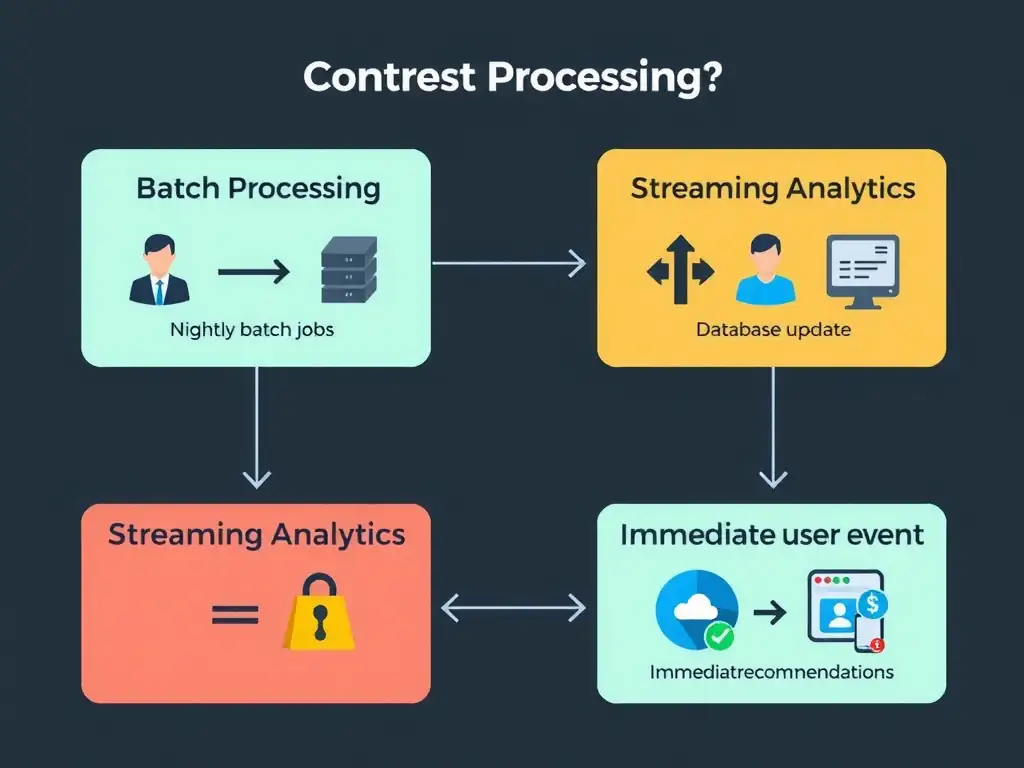
Here's the deal: if a user clicks on a sci-fi movie, you want to recommend another sci-fi movie right away, not tomorrow morning. In the real world, this is streaming analytics: you're analyzing a continuous stream of data points as they occur and making decisions on the fly. Keep it simple: real-time, continuous data analysis equals streaming analytics.
Full Explanation
AI and data processing workloads can be classified by how they ingest, process, and output data. When an application must process a continuous flow of data points generated in real time, such as user clicks, sensor readings, or financial transactions, and generate immediate insights or actions, such as product recommendations or fraud flags, it is classified as a streaming analytics workload. In this scenario, the data is processed incrementally as it arrives, and the model must perform low-latency inference to return results within milliseconds, ensuring a highly responsive user experience.
Let's contrast this with the incorrect options: - Offline training refers to the phase where a model is trained using historical datasets in a non-production environment. It is an intensive compute process that is not involved in real-time user-facing inference. - Batch processing involves collecting a large volume of data over time and processing it all at once in a scheduled job, such as an overnight job. While highly efficient for resource utilization, batch processing cannot support real-time interactions, as recommendations would only update periodically. - Reinforcement learning is a machine learning training methodology where an agent learns to make decisions by taking actions in an environment to maximize some cumulative reward. While a recommendation system could theoretically use reinforcement learning techniques to adapt over time, the execution of the model to serve real-time recommendations based on a live data stream is fundamentally a streaming analytics workload.