
An operations engineer is configuring a cluster to accelerate the training of a convolutional neural network (CNN) for a high-throughput medical imaging application. The engineer must justify the hardware procurement of NVIDIA GPUs over high-end CPUs for processing the massive dataset. Which of the following statements best describe the architectural advantages that make GPUs far more suitable than CPUs for this deep learning task? (Choose two)
Select all correct answers, then click Submit.
Short Explanation
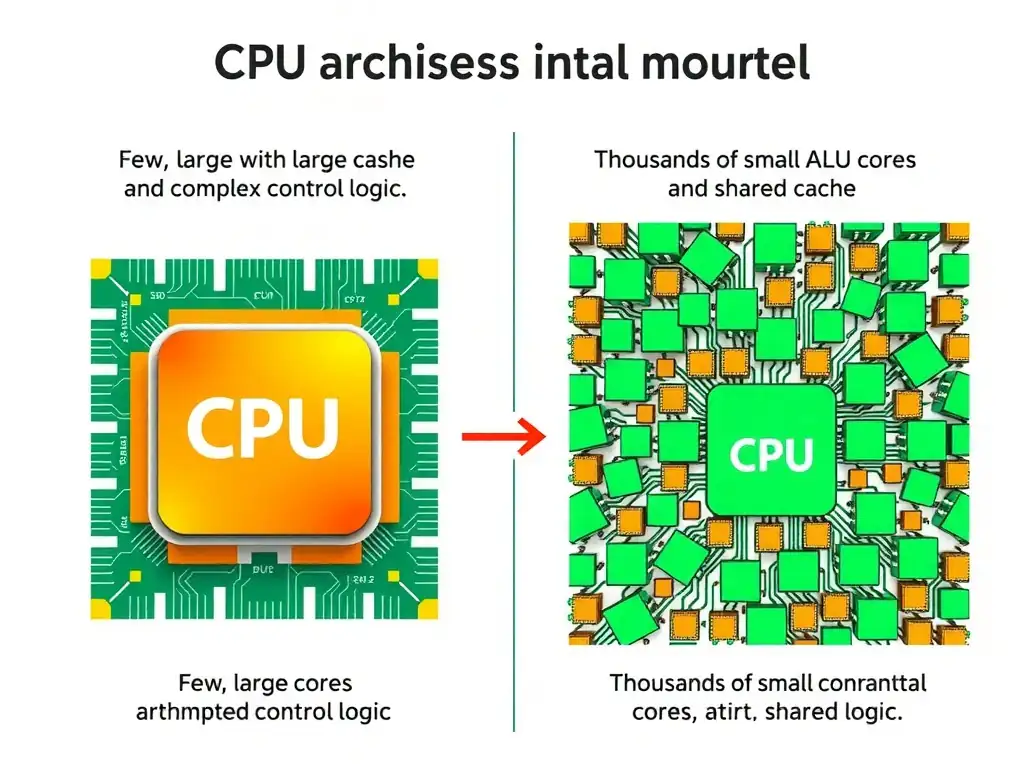
If you're training a CNN on a massive medical imaging dataset, you need parallel throughput, not a few ultra-fast cores. GPUs give you thousands of smaller cores plus Tensor Cores to hammer matrix math all at once, so they leave CPU training in the dust.
Full Explanation
Selecting the right compute hardware is critical for deep learning workloads because neural network training and inference are dominated by specific mathematical patterns. The strongest justifications are the statement that GPUs possess thousands of smaller, specialized cores that enable simultaneous execution of massive parallel workloads, and the statement that GPUs are built with specialized arithmetic logic units (ALUs) and hardware accelerators such as Tensor Cores optimized for matrix and linear algebra operations. CPUs are designed for general-purpose computing and low-latency execution of sequential tasks. They use complex control logic, large caches, and a relatively small number of highly optimized cores, often about 16 to 128 in enterprise servers. GPUs are designed for high-throughput parallel execution, often described as SIMD (Single Instruction, Multiple Data), and a single enterprise GPU can house thousands of smaller, simpler cores that perform many identical calculations at once. Deep learning layers, especially convolutional and dense layers, are built on high-dimensional matrix multiplications and additions. GPUs are architecturally optimized for that linear algebra, using high-bandwidth memory (HBM) and dedicated units such as Tensor Cores, which perform mixed-precision matrix multiply-accumulate operations in a single clock cycle and deliver orders of magnitude higher throughput than general-purpose CPU cores. The other statements are wrong. The claim that CPUs suffer from high latency when executing single-threaded scalar math while GPUs minimize individual calculation latency is backwards: CPUs generally have lower latency for individual serial calculations, while GPUs trade single-task latency for massive parallel throughput. The claim that CPUs cannot interface with high-capacity memory and that GPUs feature superior system-level cache for sequential data routing is also wrong: CPUs can interface with large memory systems and have large caches, while enterprise GPUs rely on significantly higher memory bandwidth than CPU DDR memory channels, using HBM2e or HBM3 to feed thousands of cores, not on superior system-level cache for sequential routing. The claim that CPUs are better optimized for multi-dimensional matrix multiplications because of complex branch prediction units is wrong as well: branch prediction helps sequential control flow, not the massively parallel matrix math that dominates CNN training. A related misconception is that lower total power consumption than high-end GPUs automatically makes CPUs more suitable; in practice, the long execution times of CPUs can consume much higher total energy for the same training run than a fast, efficient GPU. Therefore, the correct architectural advantages are the massive parallel core count and the specialized matrix/linear-algebra hardware.