
An operations engineer manages a shared GPU cluster running a mix of training and inference workloads. The job queue contains critical, real-time jobs alongside flexible, multi-node training tasks that can utilize parallel GPU execution, and single-GPU batch jobs. Which queue scheduling policy will minimize latency for critical workloads while maintaining high overall cluster utilization?
Select an answer to reveal the explanation.
Short Explanation
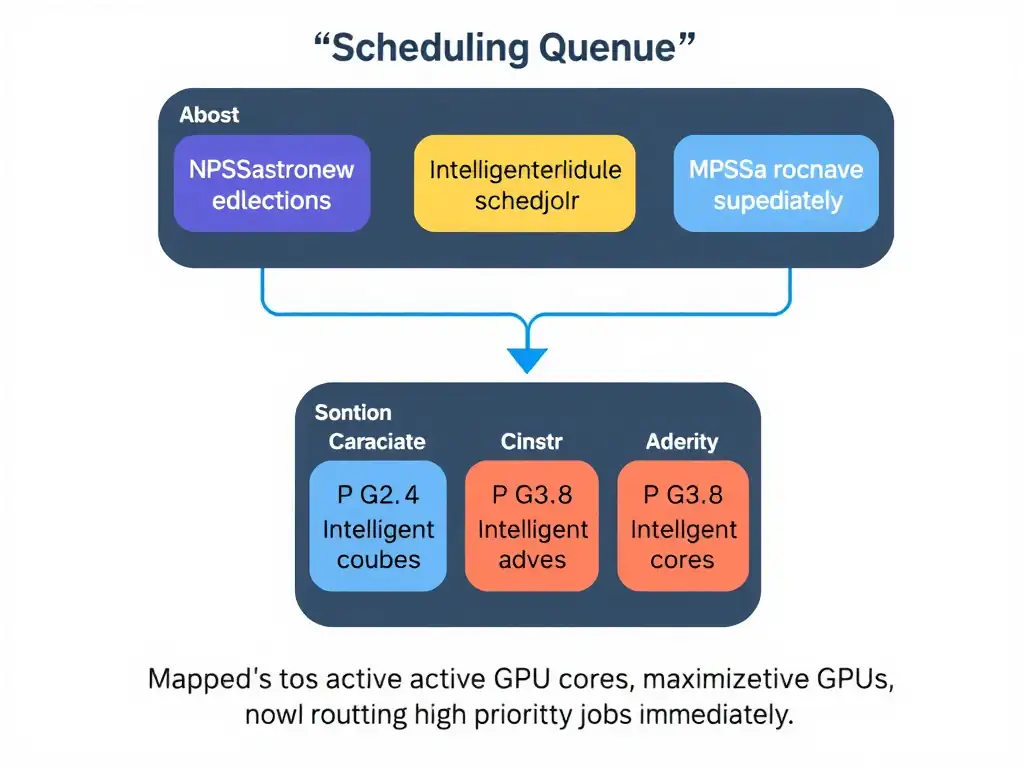
If a critical real-time job gets stuck behind a massive training run, you're having a bad day. Use a priority-aware scheduler that checks urgency, idle GPUs, and whether a job can run across multiple GPUs. It keeps critical work fast while keeping the cluster busy.
Full Explanation
Managing shared computational resources in an enterprise AI cluster requires balancing two conflicting objectives: meeting strict service-level agreements (SLAs) for critical, latency-sensitive tasks, and maximizing overall hardware efficiency (GPU utilization). The priority-aware scheduler that dynamically evaluates job urgency, GPU resource availability, and a job's ability to run in parallel resolves this by dynamically allocating resources based on multi-dimensional criteria: 1. Urgency/Priority: Critical jobs are bumped to the front of the execution queue or allowed to pre-empt lower-priority workloads. 2. Resource Requirements & Availability: The scheduler matches jobs to the exact GPU topography (e.g., NVLink-connected pairs) they require. 3. Parallelizability: Jobs that can scale across multiple nodes are allocated dynamically to absorb idle capacity, while non-parallelizable tasks are confined to single devices, preventing resource fragmentation.
The strict First-Come, First-Served (FCFS) queue that executes jobs in the exact order received causes "head-of-line blocking," where a massive, non-critical training job halts all subsequent workloads, including urgent, real-time tasks.
The static round-robin scheduler that allocates equal GPU time slices to all submitted jobs regardless of size or deadline introduces excessive context-switching overhead on GPUs, which is computationally expensive due to VRAM state swap times, and fails to prioritize time-sensitive workloads.
The longest-job-first scheduler that prioritizes multi-day training runs to minimize setup and teardown overhead systematically starves short, critical tasks, leading to unacceptable latency spikes for active users or automated systems relying on real-time model outputs.