
A systems administrator is configuring a virtualized cluster to host development environments for a team of AI researchers. To maximize the density of virtual machines (VMs) per physical server, the administrator allocates virtual GPU (vGPU) profiles to twenty VMs on a host equipped with only four physical GPUs, relying on temporal sharing. The researchers quickly report that training jobs run drastically slower than they do on bare-metal systems. Which of the following virtualized design choices is the primary cause of this performance degradation?
Select an answer to reveal the explanation.
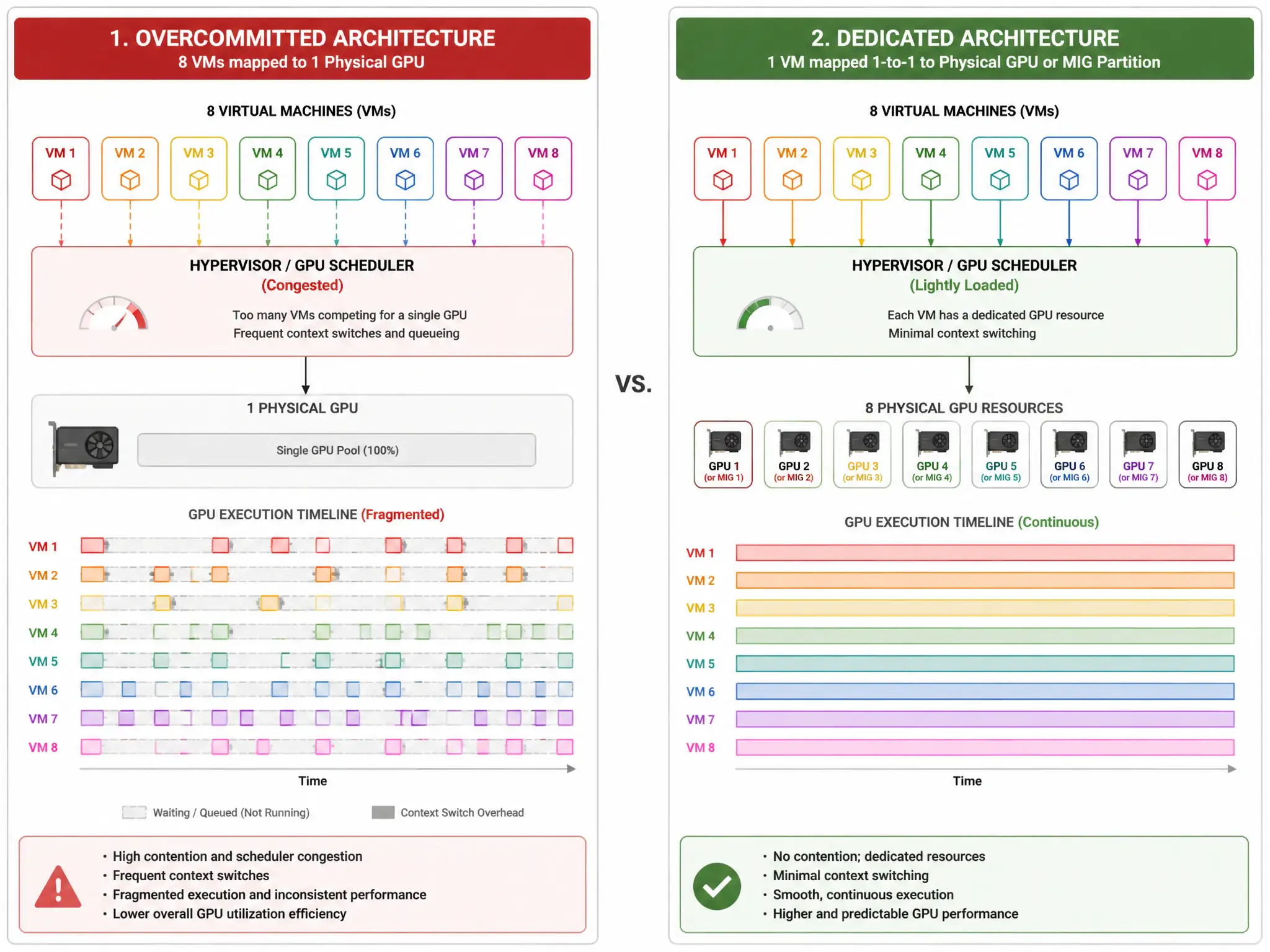
Short Explanation
You overcommitted the physical GPUs across too many VMs, and GPUs don't like that the way CPUs do. A training job pegs the GPU at full tilt, so sharing one GPU among many VMs forces constant context switching, kills caches, and wrecks throughput. If you want bare-metal performance, give the VMs dedicated GPU allocation instead of temporal sharing.
Full Explanation
In virtualized enterprise environments, resource overcommit is a common strategy for CPUs and RAM, allowing administrators to run more virtual workloads than physical hardware would normally permit. However, GPUs are highly sensitive to overcommitment. AI workloads, such as deep learning training, are computationally intensive and continuously run at maximum capacity for long durations. When multiple VMs share a single physical GPU through temporal sharing, the hypervisor must continuously context-switch the GPU's state (including registers, memory mappings, and instruction queues) between the competing VMs. This frequent context switching introduces massive scheduling latency, flushes caches, and degrades training throughput. To avoid this performance penalty, virtualized AI infrastructures should avoid overcommitting GPU resources and instead allocate dedicated physical GPUs to VMs (using PCIe pass-through) or use strict hardware partitioning such as Multi-Instance GPU (MIG) where resources are statically isolated.
The other choices are less relevant to the primary bottleneck. Deploying VMs on standard SSD storage rather than high-performance NVMe drives may slow down initial data loading but does not account for a massive drop in GPU compute speed. Enabling VM high availability clustering features is a clustering feature that automates failover and has negligible impact on runtime computational performance. Utilizing standard bridged virtual network interfaces instead of SR-IOV primarily degrades network communication performance in multi-node clusters, but the local performance drop on a single host is directly driven by GPU resource contention.