
Your engineering team is designing a custom high-performance computing (HPC) facility to house clusters dedicated to training trillion-parameter transformer models. During the design review, you identify that traditional DDR5 memory architectures will cause a severe bottleneck, starving the processing cores of data during backpropagation. Which memory integration design choice is essential within the GPU clusters to support this level of data-intensive throughput?
Select an answer to reveal the explanation.
Short Explanation
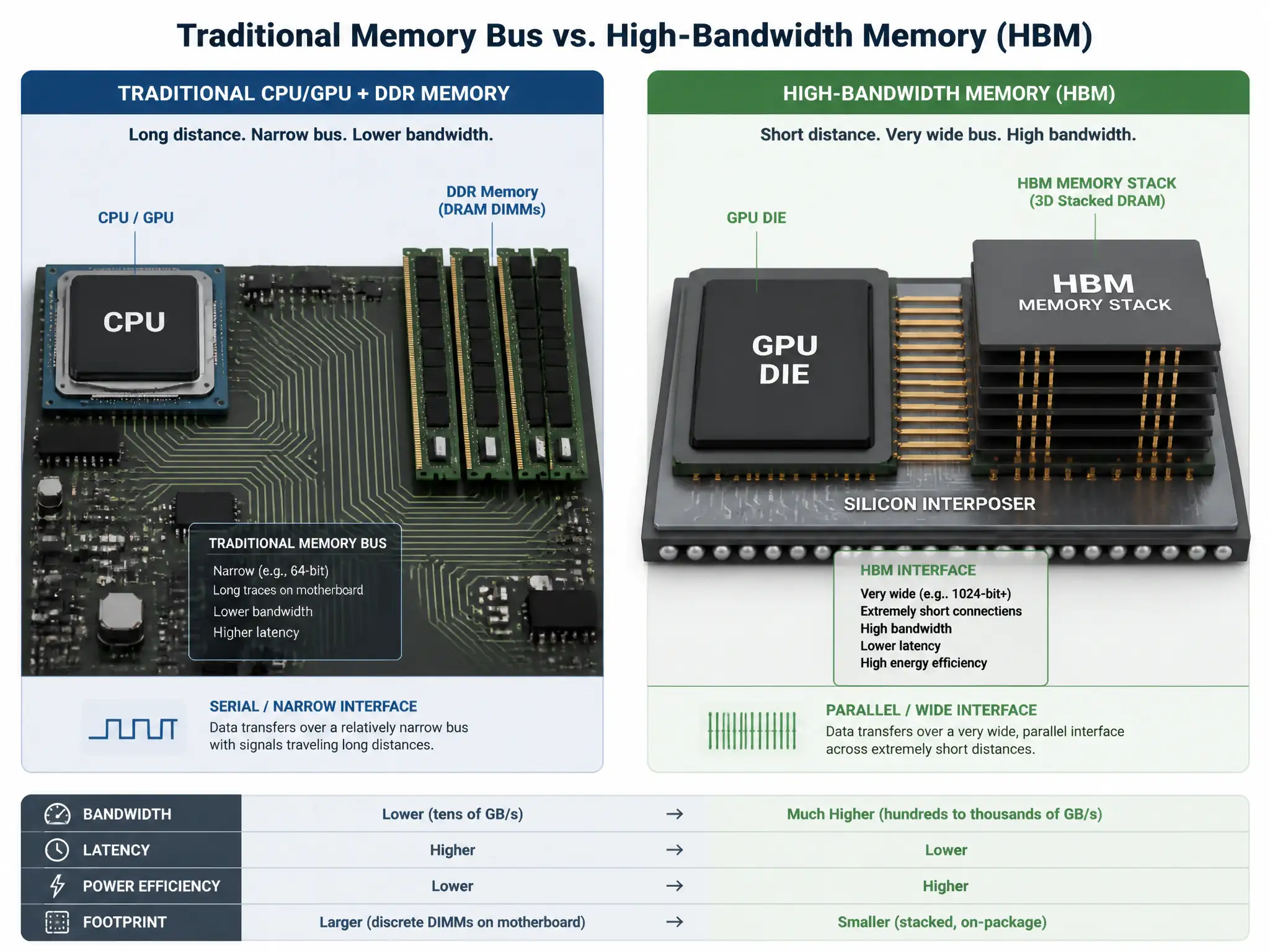
If you've got the fastest GPU cores but feed them through a straw, they'll sit idle. HBM stacks memory right on the GPU package over a wide silicon interposer, giving a multi-lane data superhighway. For heavy AI training, that bandwidth is mandatory.
Full Explanation
AI and deep learning workloads require processing massive quantities of data at extreme speeds. The performance of these workloads is heavily dependent on memory bandwidth. Traditional memory configurations, such as DDR5 or even GDDR6, connect memory modules to the processor via motherboard buses, which severely limits throughput. High-Bandwidth Memory solves this by stacking memory dies vertically through 3D stacking and placing them directly on the same silicon package as the GPU processor, connected by a high-density silicon interposer. This design allows for a bus width of 1024 bits or wider per stack, yielding memory bandwidth of several terabytes per second. This ensures that the highly parallel GPU compute cores remain saturated with data during intensive tensor operations.
Other choices are not suitable for this problem. Implementing high-density virtual memory paging across NVMe drives is extremely slow and introduces massive latencies that would halt training progress. Maximizing the capacity of shared DDR5 system memory across the host CPU sockets does not solve the bandwidth bottleneck because the data must still travel across the PCIe bus to reach the GPU, which acts as a major bottleneck. Finally, utilizing high-frequency L1/L2 cache mirroring across all nodes in the cluster is technically impossible and conceptually flawed, as L1 and L2 caches are localized, on-die memories designed for immediate processor core execution, and mirroring them over a network would create crippling latency.