
An operations engineer is running a massive distributed training pipeline across several multi-GPU nodes. During monitoring, they notice significant jitter in job completion times and highly uneven load distribution: some GPUs spike to 100% capacity while others sit idle or fluctuate wildly, waiting for synchronization. The systems team suspects that worker processes are frequently migrating between sockets and GPUs, leading to massive cache misses and PCIe bus contention. Which of the following scheduling strategies should be implemented to solve this overhead and balance the workload?
Select an answer to reveal the explanation.
Short Explanation
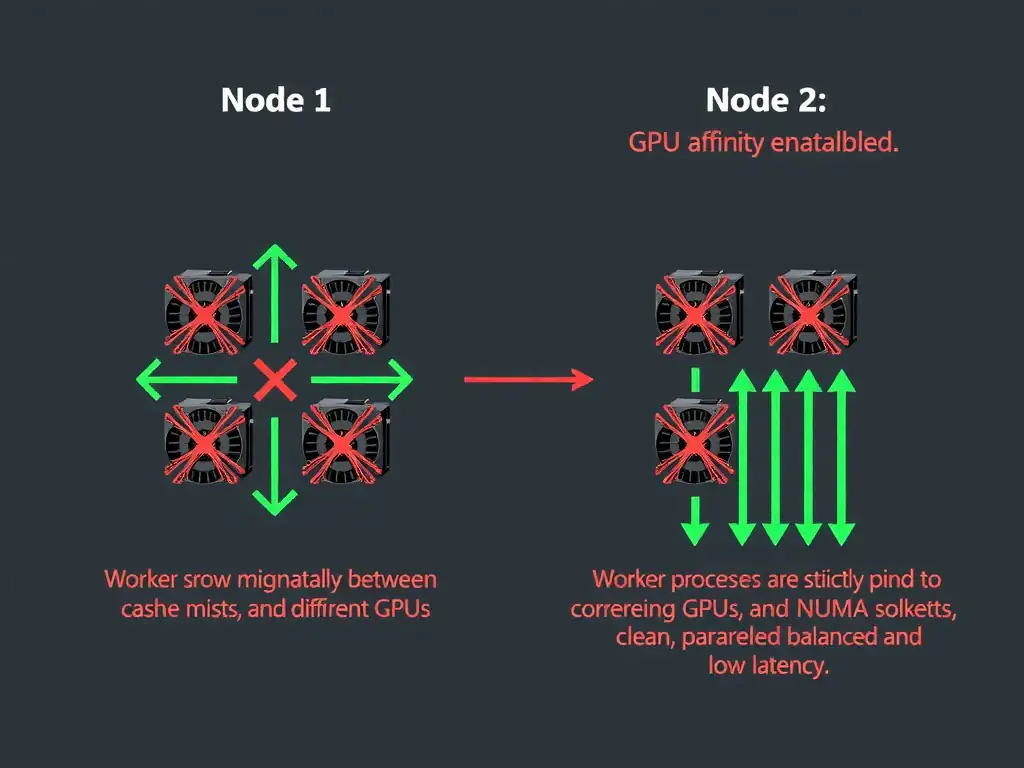
Here's the deal: if you let your cluster scheduler slide tasks around from one GPU to another, you're killing performance. By enabling GPU affinity and socket binding in the scheduler, you pin each worker to a physical GPU and its nearest CPU socket, so caches stay hot and PCIe/NVLink traffic stops bouncing around. That's one of the quickest wins for stabilizing job completion times.
Full Explanation
The correct strategy is to enable GPU affinity and socket binding in the cluster job scheduler. In multi-node, multi-GPU clusters running high-performance deep learning workloads, process migration across CPU sockets or GPU devices introduces severe performance bottlenecks. GPU affinity, also known as device binding, ensures that specific worker processes are bound to dedicated physical GPUs and their nearest CPU NUMA sockets. Without GPU affinity, the operating system's scheduler may shift running threads across different processors and sockets to balance load. This migration invalidates first- and second-level caches and forces data transfer over slower inter-socket interconnects or host PCIe buses instead of local high-speed interconnects like NVLink. By binding tasks directly to the GPU/socket topology, communication overhead is minimized, and resource utilization becomes uniform across the cluster.
Looking at the alternatives, configuring static CPU core-pinning on the container runtime prevents CPU thread migration but does not handle mapping containers to specific GPU hardware or solve the underlying PCIe topology bottleneck. Implementing dynamic CPU load balancing at the kernel level is counterproductive because it increases the frequency of thread migration across CPU cores, worsening cache thrashing in GPU-accelerated pipelines. Increasing the batch size of the workload does not resolve worker process mapping issues; instead, it increases memory pressure on all devices, which could make the performance bottleneck even worse and potentially lead to out-of-memory crashes on the overloaded nodes.