
An engineering team is building a real-time computer vision system for an automated sorting facility. The system must inspect high-resolution video streams from conveyor belts, identify various defective items, and categorize them in milliseconds. Which methodology should the team implement to handle this complex, real-time spatial image classification task?
Select an answer to reveal the explanation.
Short Explanation
Think about how you look at a photo: you don't read raw pixel numbers or run a thousand-rule checklist; you see shapes, edges, and features. That's exactly how convolutional neural networks work, sweeping filters across grid-like image data to detect edges, shapes, and full objects in milliseconds. For fast, accurate image classification, they're the undisputed king—remember that for the exam!
Full Explanation
Computer vision tasks, such as real-time object detection and classification in video streams, present unique computational challenges. Images are high-dimensional data structures where spatial relationships between pixels are critical for understanding content. Traditional algorithms struggle to process this data efficiently in real time.
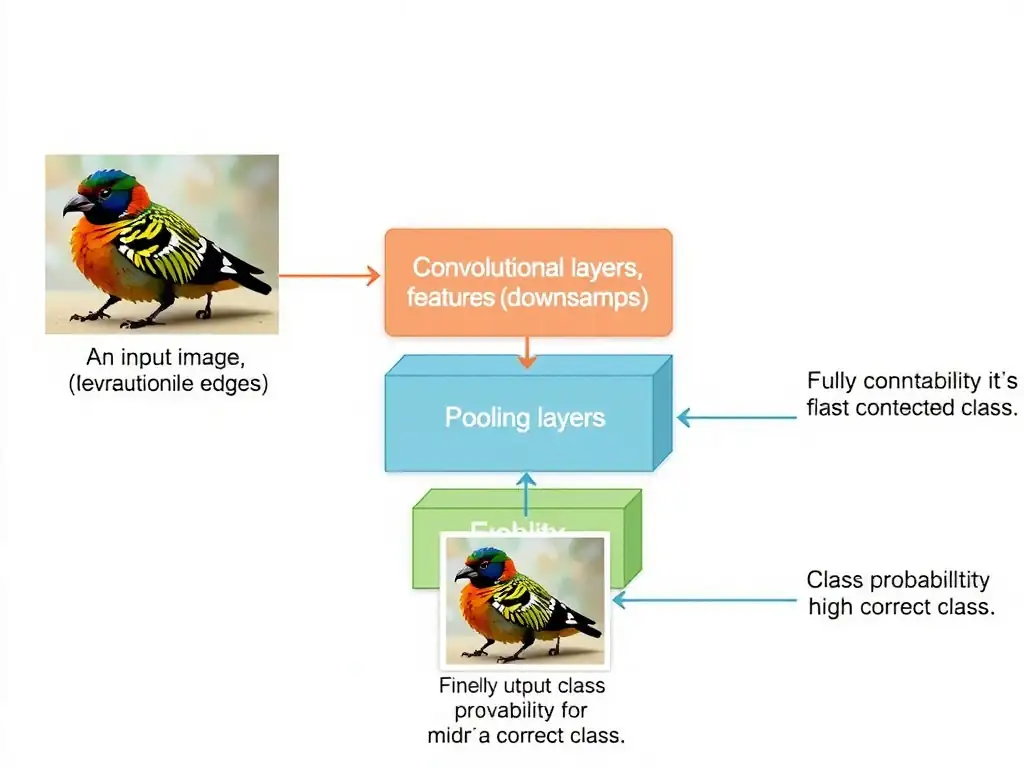
Convolutional neural networks are a class of deep neural networks designed specifically for processing grid-structured data like images. They utilize convolutional layers, which apply mathematical filters to input images to extract spatial hierarchies of features. The early layers might detect simple features like edges and gradients, while deeper layers combine these features to detect complex shapes, textures, and eventually full objects, such as defects, pedestrians, or vehicles. This hierarchical feature learning is automated and extremely robust to variations in lighting, rotation, and scale, making convolutional neural networks the standard choice for low-latency, high-accuracy computer vision applications.
The rule-based expert system that evaluates hardcoded pixel-intensity thresholds relies on human-defined rules, such as treating a pattern of red pixels in a circle as a stop sign. It fails immediately in real-world scenarios due to changes in lighting, angles, weather, and occlusions, because it is impossible to write rules for every variation.
The multivariate linear regression model using raw camera pixel values as input features is designed to predict continuous numeric values based on linear relationships. It lacks the capacity to model the highly non-linear relationships found in raw image pixels.
The unsupervised K-medoids algorithm that clusters pixels based on spatial proximity groups data using raw distance metrics. It does not learn semantic classes, such as identifying a pedestrian or a defective part, and it is too slow and inaccurate for real-time classification.
Therefore, implementing a deep learning architecture that leverages convolutional neural networks is the most effective approach for real-time image classification.