
An enterprise runs distributed machine learning training jobs across an infrastructure consisting of local private cloud GPUs and public cloud instances. Lately, the training runs have suffered from unpredictable latency spikes, uneven GPU utilization, and occasional node failures that abort active runs. Which mechanism should the team deploy to dynamically route computational tasks, maintain high availability, and balance traffic between the local and public cloud resources?
Select an answer to reveal the explanation.
Short Explanation
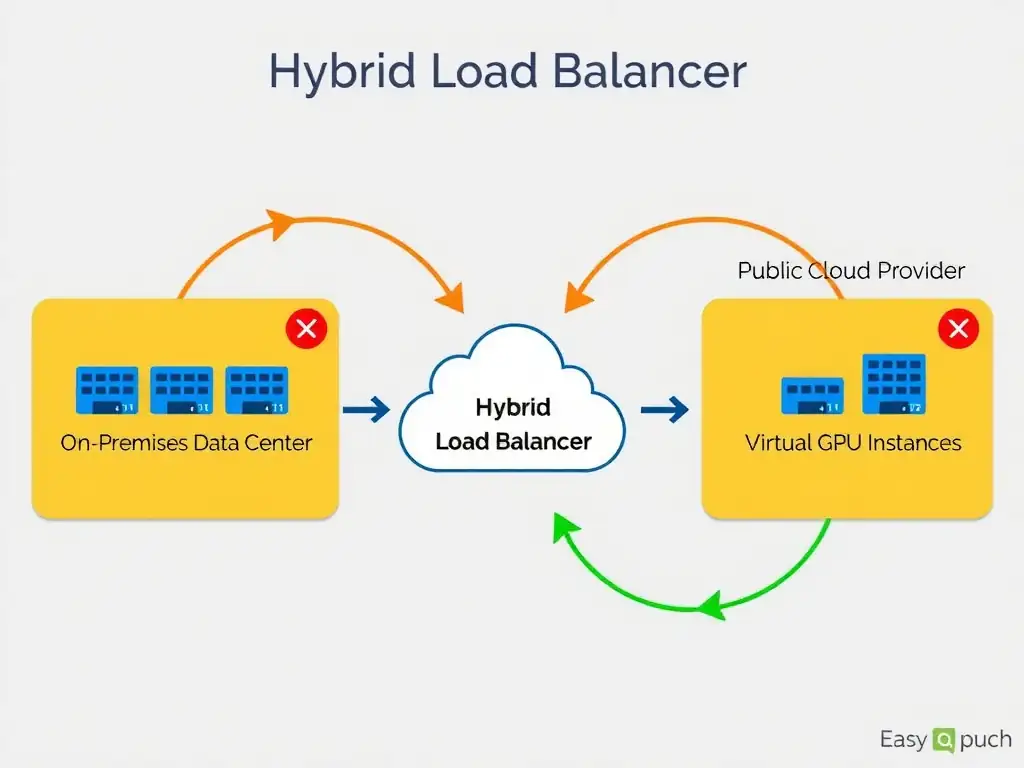
Here's the deal: you're running GPUs on-prem and in the cloud, so you need a traffic cop that knows both. A hybrid load balancer watches health and load, spills work to cloud when local nodes are slammed, and fails over when a node drops. That keeps training jobs running and gives you high availability.
Full Explanation
In hybrid computing architectures, workloads are split between on-premises infrastructure and public cloud services. While this offers flexibility and cost optimization, it also introduces challenges regarding network latency, resource availability, and compute scheduling. If training jobs are statically mapped, any hardware failure or congestion on one side will lead to idle compute time, data transfer bottlenecks, or failed training sessions.
A hybrid load balancer solves this by dynamically distributing computational tasks across the entire pool of resources based on real-time metrics such as node health, current GPU utilization, queue depth, and network latency. If an on-premises GPU node fails or becomes overloaded, the load balancer automatically reroutes traffic to available cloud instances, ensuring high availability and mitigating performance fluctuations.
Let's analyze why the other approaches are less effective: - Consolidating all training datasets into a single remote storage bucket might simplify data management, but it doesn't address compute scheduling, node failures, or dynamic load balancing of active GPU tasks. Indeed, it could worsen latency for local compute resources. - Moving all compute tasks to a single public cloud vendor's proprietary virtual machines removes the hybrid capability entirely, potentially increasing costs and locking the organization into a single vendor, without resolving the underlying need for active load management. - Performing a clean installation of the latest GPU drivers across all host operating systems is a good maintenance practice, but it does not address network-level load distribution, high availability, or cross-environment failover.
A hybrid load balancer provides the routing intelligence needed to orchestrate workloads across disparate environments, ensuring robust and consistent execution of distributed AI training.