
You are analyzing a massive customer dataset containing millions of rows and hundreds of demographic, behavioral, and transactional features. To make this high-dimensional dataset manageable and discover hidden groupings or segments of similar customer behavior to target with marketing campaigns, which two techniques should you apply? (Select two)
Select all correct answers, then click Submit.
Short Explanation
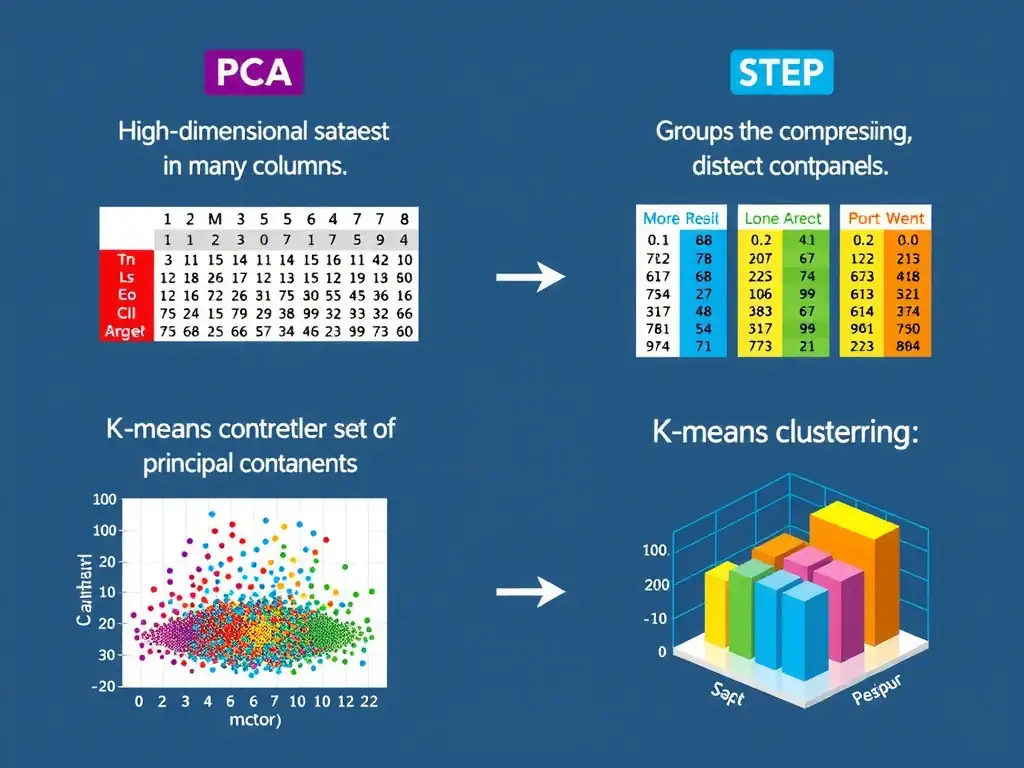
You've got millions of rows and hundreds of features, so you need to shrink the feature space and find groups. Use PCA to reduce dimensions while preserving variance, then use K-means clustering to group similar customers. SMOTE, image data augmentation, and batch normalization solve different problems.
Full Explanation
When dealing with large-scale, high-dimensional datasets, data scientists face the 'curse of dimensionality,' where the volume of space increases so rapidly that the available data becomes sparse, making data analysis and pattern discovery difficult. To extract meaningful insights, two primary steps are commonly taken: reducing dimensions and grouping similar data points.
Principal Component Analysis (PCA) is an unsupervised dimensionality reduction technique that transforms a large set of variables into a smaller one that still contains most of the information (variance) of the original set. By reducing the number of variables, PCA simplifies visualization, accelerates model training, and filters out noise.
K-means clustering is an unsupervised learning algorithm that partitions the dataset into K distinct, non-overlapping subgroups (clusters). It groups data points based on their feature similarity, allowing organizations to identify natural patterns and customer segments.
The synthetic minority over-sampling technique (SMOTE) is incorrect because it addresses class imbalance in classification datasets by generating synthetic examples of the minority class. It does not reduce dimensions or group data to extract insights.
Image data augmentation is incorrect because it is used in deep learning, particularly with computer vision, to increase the diversity of training data by applying transformations such as rotations or flips. It is not used for reducing tabular dimensions or clustering.
Batch normalization is incorrect because it is used during the training of deep neural networks to normalize the inputs of each layer, stabilizing and accelerating the training process. It does not extract patterns or reduce dataset dimensions.
Combining PCA and K-means is a standard workflow: PCA reduces the feature space to avoid the curse of dimensionality, and K-means is then applied to the principal components to find clusters.