
A system administrator is deploying a cluster of hypervisors equipped with multiple physical CPUs and PCIe-attached GPUs to host high-performance deep learning workloads. To prevent extreme latency spikes and memory throughput bottlenecks between the system memory and the GPU memory, which architectural factor must the administrator configure?
Select an answer to reveal the explanation.
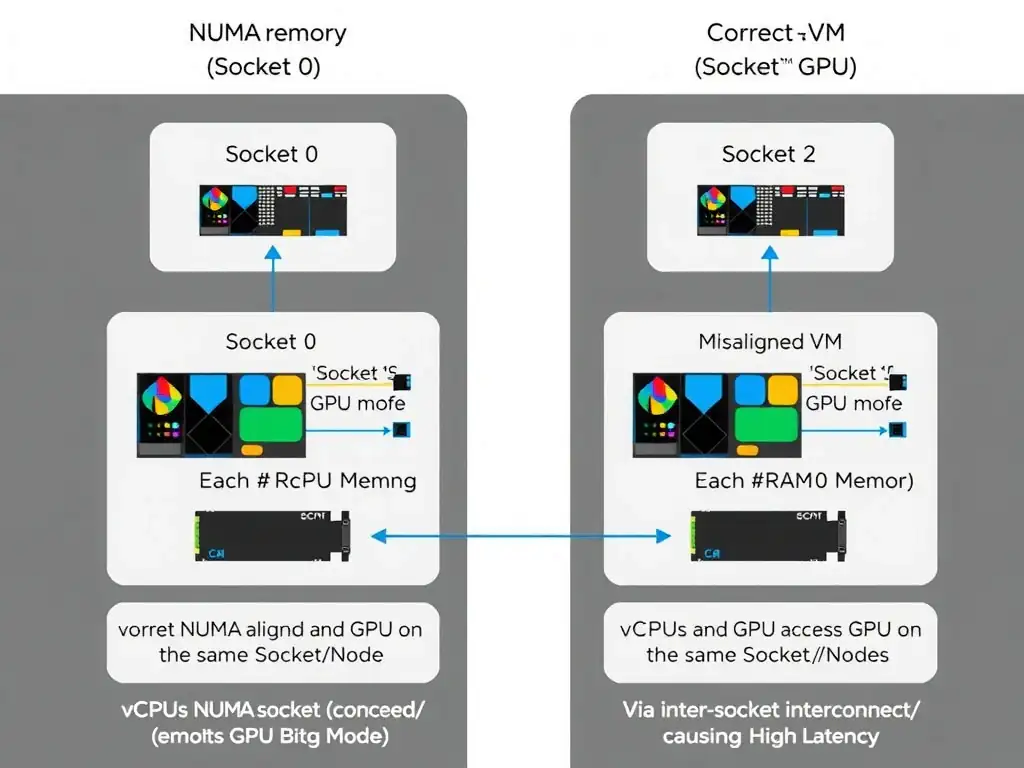
Short Explanation
When you're running heavy AI workloads, speed is everything. If your VM's vCPUs and GPU aren't on the same NUMA node, data has to cross the inter-socket link, and that latency will kill training performance. Align them to the same physical NUMA node to keep memory access local and throughput high.
Full Explanation
Modern multi-socket servers utilize a Non-Uniform Memory Access architecture. Under this model, system memory is divided into local regions associated directly with specific physical processors. When a CPU accesses its local memory, latency is minimal. However, if a CPU needs to access memory associated with a different processor socket, the request must cross an interconnect such as Intel UPI or AMD Infinity Fabric, which introduces significant latency and reduces available bandwidth.
In a GPU-accelerated virtualized environment, GPUs are connected via PCIe to specific CPU sockets. If a virtual machine is scheduled on vCPUs residing on one socket but is mapped to a physical GPU connected to another socket, every transaction between the VM's CPU threads and the GPU must cross the inter-socket link. This misaligned configuration causes severe bottlenecks during high-throughput AI training and inference.
Let's review the other choices: - The software-emulated vGPU approach rather than direct PCIe passthrough introduces massive virtualization overhead and lacks the performance required for hardware-accelerated AI workloads, whereas direct hardware passthrough or hardware-backed vGPU is preferred. - The vCPU overcommit approach, which allocates more virtual CPUs than physical CPUs, degrades performance for compute-intensive AI workloads due to context switching and scheduling latency. - The approach of distributing GPU memory allocations evenly across all available physical RAM sockets actively breaks NUMA locality, forcing remote memory accesses and degrading data transfer performance between system RAM and GPU VRAM.
Therefore, aligning virtual machine resources to the same physical NUMA node as the assigned GPU ensures that memory access paths remain local, keeping latency low and throughput high.