
An engineering team is developing a predictive maintenance system for factory machinery. They train a deep neural network with millions of parameters and a simple linear regression model. During evaluation on new, unseen sensor data, the deep neural network exhibits a much higher Mean Squared Error (MSE) than the linear regression model, despite having achieved near-zero error on the training set. What is the most likely reason for this discrepancy?
Select an answer to reveal the explanation.
Short Explanation
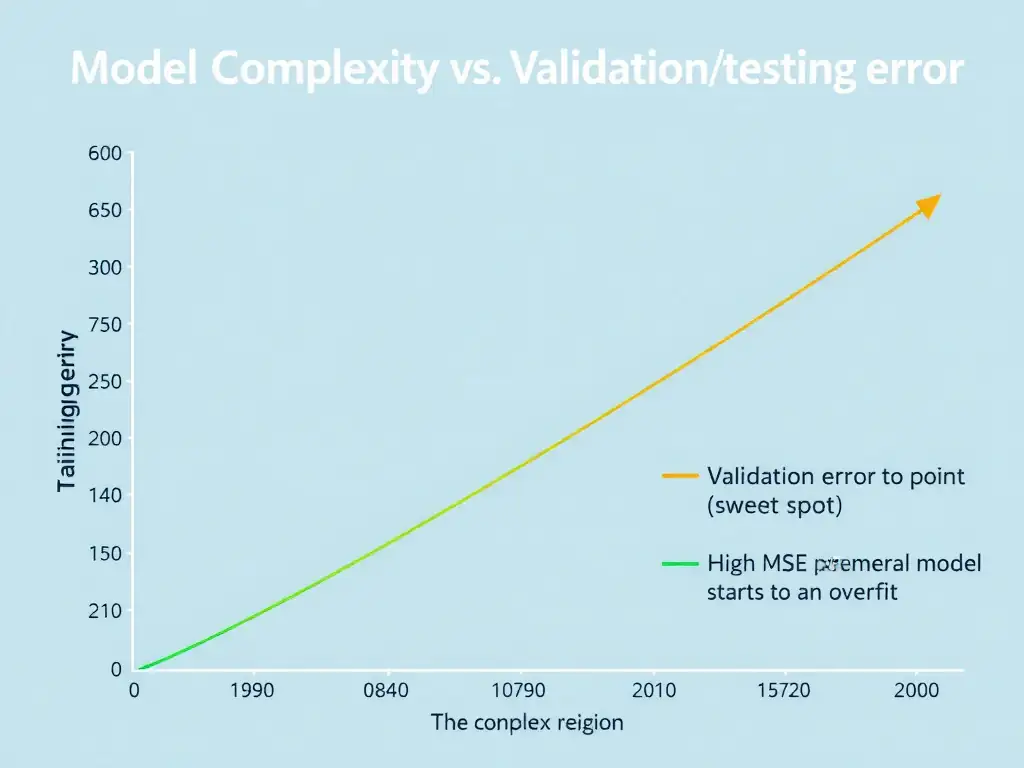
Check this out: you train a massive neural net and it memorizes noise instead of real patterns. On new sensor data, that overfitting blows up MSE while a simple linear model generalizes better. It's classic overfitting.
Full Explanation
In machine learning, model complexity is a double-edged sword. While a highly complex model, such as a deep neural network with many layers and parameters, has the capacity to represent highly non-linear relationships, it is also extremely susceptible to overfitting. Overfitting occurs when a model captures the random noise, outliers, and training-specific fluctuations of the training set rather than the underlying data-generating distribution. As a result, the model performs exceptionally well on the training data, even near-zero error, but fails to generalize to unseen evaluation or testing data, leading to a high Mean Squared Error (MSE).
Let's break down why the other choices do not explain this scenario: - The claim that the simple model is underfitting the training data describes a model that is too simple to capture the underlying patterns, which would result in poor performance on both the training and testing datasets. Since the complex model is the one performing poorly relative to simpler models, underfitting is highly unlikely. - The claim that the learning rate was set too low during training slows down the optimization process, meaning the model might take a long time to converge. However, if given enough epochs, it can still converge, or it might underfit if stopped early. It does not inherently cause a more complex model to perform worse than a simpler model on test data if both are trained. - The claim that there is an implementation error in the loss function calculation is an implementation bug that would affect all models using that codebase equally, or would fail compile/runtime checks. It is not a statistical reason why a more complex model would specifically exhibit high MSE on validation data while simpler models perform better.
To combat overfitting in complex models, machine learning practitioners use regularization techniques, such as L1/L2 regularization, dropout, or early stopping, and cross-validation to ensure the model generalizes well to new datasets.