
An enterprise security system is deploying a massive computer vision model for real-time video stream analysis. The system must process hundreds of feeds simultaneously, maintain high availability across server nodes, and keep inference latency under 10 milliseconds. Which combination of NVIDIA technologies will optimize the inference execution speed on individual GPUs and provide the high-speed hardware-level inter-GPU communication needed for distributed scaling?
Select an answer to reveal the explanation.
Short Explanation
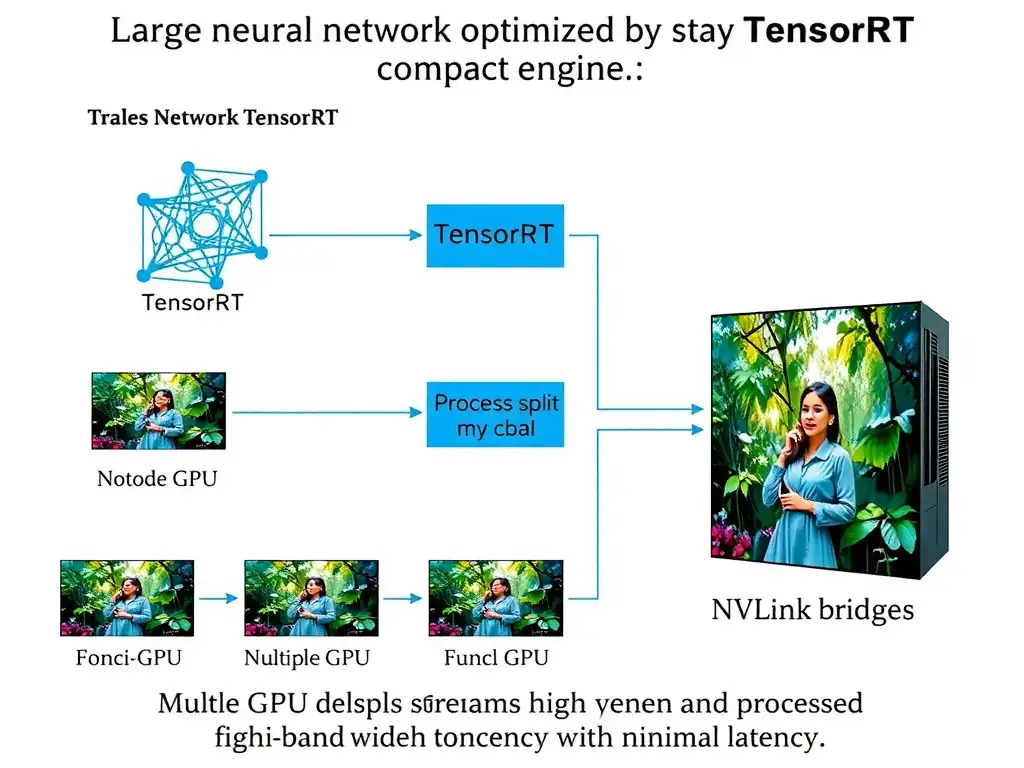
Here's the deal: when you're deploying real-time video analysis at scale, you need the model to run as fast as possible on each GPU and the GPUs to share data without a slow bottleneck. TensorRT compiles and optimizes your neural network to cut latency, while NVLink gives the GPUs a direct high-speed interconnect for fast memory sharing across cards. Put them together, and you get ultra-low latency and scalable high performance.
Full Explanation
Deploying large-scale computer vision models for real-time analysis requires addressing performance constraints at both the software runtime level and the hardware communication level.
1. Software model optimization: NVIDIA TensorRT is an inference optimization engine and runtime. It takes trained deep learning models and optimizes them by fusing layers, quantizing precision, such as converting FP32 to FP16 or INT8, and matching execution parameters to the specific GPU architecture. This significantly reduces execution latency and increases throughput on each individual GPU. 2. High-speed interconnect: NVIDIA NVLink provides a direct, high-bandwidth, low-latency interface for GPU-to-GPU communication. When models are split across multiple GPUs, such as model parallelism, or when data must be shared rapidly between co-processors, NVLink bypasses the host CPU and the high-latency PCIe bus. This allows the GPUs to share a unified memory space and communicate at speeds up to hundreds of gigabytes per second, enabling seamless scaling and high availability.
The Triton Inference Server and GPUDirect RDMA combination is not the best answer because Triton Inference Server is a software orchestrator for model deployments and GPUDirect RDMA enables network transfers directly to GPU memory, but they do not optimize the model execution the way TensorRT does or provide the local physical high-speed GPU-to-GPU interconnect that NVLink provides.
The Clara Deploy SDK and BlueField-3 DPUs combination is not the best answer because Clara Deploy SDK is restricted to healthcare imaging workflows, and BlueField DPUs offload networking and security tasks, which does not directly address model optimization and core inter-GPU computing scaling.
The CUDA and NCCL combination is not the best answer because CUDA is the base parallel programming platform, and NCCL, the NVIDIA Collective Communications Library, is a communications library primarily used during the model training phase for synchronization, such as AllReduce, rather than serving optimized inference models.
Therefore, the combination of TensorRT for software optimization and NVLink for hardware interconnect is the most effective solution for minimizing inference latency and enabling high-availability GPU scaling.