
In a shared Kubernetes cluster running deep learning training jobs, low-priority development pods often consume all available GPUs, causing urgent production retraining jobs to sit in a 'Pending' state. What is the most effective native Kubernetes mechanism to ensure that urgent, high-priority pods can immediately claim GPU resources by stopping lower-priority jobs?
Select an answer to reveal the explanation.
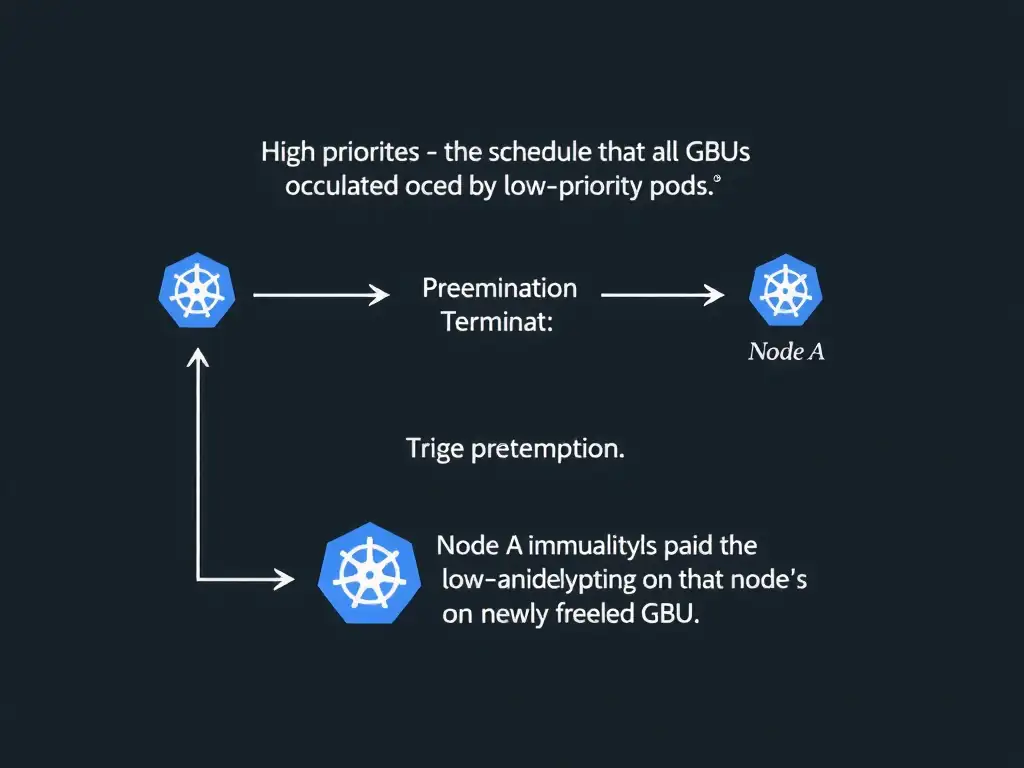
Short Explanation
Here's the deal: when urgent production retraining needs GPUs now, you use Pod Priority and Preemption so Kubernetes can evict lower-priority dev pods and free the GPUs immediately. Assign high priority to production and low priority to dev workloads, then let the scheduler do the brutal work for you.
Full Explanation
In multi-tenant Kubernetes clusters, resource contention is inevitable. When accelerated workloads (like GPU-based training) are scheduled, they require specialized, finite resources. Without proper controls, less critical workloads can monopolize GPUs, preventing high-priority production jobs from running.
The native Kubernetes solution for this is Pod Priority and Preemption. This feature consists of two main components: 1. Pod Priority: Administrators define PriorityClass objects, which assign a numeric priority value to different workloads (e.g., production-critical with a priority of 1,000,000, and development-test with a priority of 1,000). Pods are then configured to use these PriorityClasses. 2. Preemption: When a high-priority pod is scheduled and there are no nodes with sufficient resources (such as free GPUs), the Kubernetes scheduler searches for running pods with lower priority. It then evicts (preempts) those lower-priority pods from a node, freeing up the required GPU resources so that the high-priority pod can be scheduled immediately.
Let's look at why the other approaches are incorrect: The node affinity approach, to restrict high-priority pods to a set of dedicated worker nodes, only constrains which nodes a pod can be scheduled on. It does not resolve resource contention; if the targeted nodes are already full of low-priority pods, the high-priority pod will still sit in a 'Pending' state. The Horizontal Pod Autoscaler approach, to spin up new VM nodes in the cloud automatically, scales the number of pods based on metrics like CPU or memory. While cluster autoscaling can add physical nodes, provisioning a new GPU node in the cloud typically takes several minutes. Preemption provides immediate resource availability by evicting local pods. The manual scheduling approach, where administrators write scripts to kill running pods when a new job arrives, is highly inefficient, error-prone, and slow. It introduces operational overhead and does not leverage the native, automated scheduling capabilities of Kubernetes.