
When designing a virtualized infrastructure to support multiple virtual machines (VMs) running AI inference and design workloads, which technology should you implement to dynamically allocate physical GPU resources to virtual machines?
Select an answer to reveal the explanation.
Short Explanation
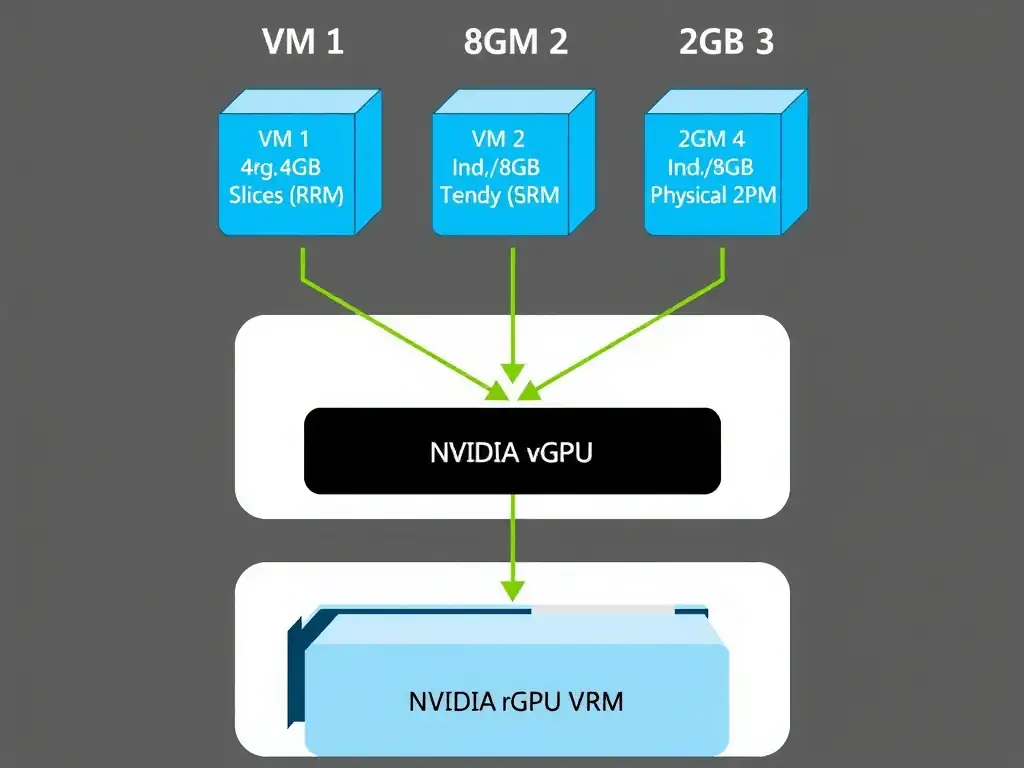
You want NVIDIA vGPU software because it slices a physical GPU into virtual GPU instances and shares it among multiple VMs. It lets the hypervisor allocate GPU memory and compute dynamically, so AI inference and design workloads get real GPU acceleration without wasting a whole card on one VM.
Full Explanation
Virtualizing GPU resources is essential for cloud providers and enterprise data centers to maximize hardware utilization and flexibility. When multiple virtual machines require GPU acceleration for AI workloads, simply passing through an entire physical GPU to a single VM, using Direct Device Assignment or Passthrough, is highly inefficient and does not scale. NVIDIA vGPU (virtual GPU) software solves this by allowing a physical GPU to be shared among multiple virtual machines. The vGPU software manager, integrated into hypervisors like VMware ESXi or Red Hat KVM, creates virtual GPU instances from the physical hardware. Each VM is assigned a vGPU profile, which defines the amount of frame buffer (VRAM) and GPU compute engines allocated to it. The physical GPU's Streaming Multiprocessors (SMs) are scheduled dynamically among the VMs, ensuring that workloads receive GPU acceleration when needed while maintaining isolation and security between VMs. Disabling hardware virtualization and allocating raw CPU resources via hypervisor thread-pinning is incorrect because it does not provide GPU acceleration; CPU-only execution is highly inefficient for parallelizable AI workloads like deep learning inference. Assigning a dedicated physical PCIe storage controller to each VM using DirectPath I/O is incorrect because passthrough for storage controllers does not solve the problem of sharing GPU compute resources; it only addresses storage I/O and does not provide GPU virtualization. Standard VM CPU-emulated graphics drivers, which bypass physical GPU hardware entirely, are incorrect because those drivers run entirely on the host CPU, lack the parallel processing units such as CUDA cores and Tensor cores of a physical GPU, and result in extremely slow performance for AI workloads.