
Your team is transitioning a deep learning model training workload from high-performance multi-core CPUs to NVIDIA GPUs. The model processes massive datasets and performs complex matrix multiplications. Which fundamental architectural feature makes GPUs more suitable than CPUs for this task?
Select an answer to reveal the explanation.
Short Explanation
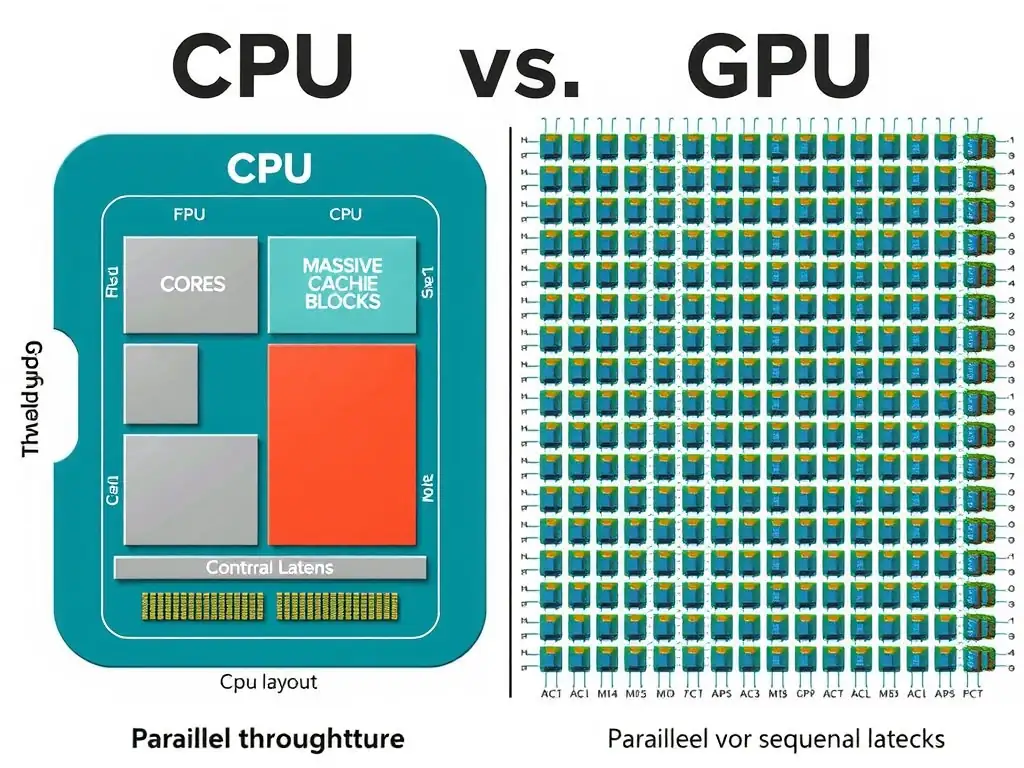
Think of it like this: the CPU is like the Ferrari, while the GPU is like the fleet of mini-buses. Deep learning is massive matrix math, so you want thousands of simple cores crunching calculations at once. Don't get fooled on the exam: CPUs usually have bigger caches and higher clock speeds than GPUs.
Full Explanation
The fundamental difference between CPU and GPU architectures lies in their design philosophies. The Central Processing Unit is designed for general-purpose sequential computing. It features few powerful cores optimized to execute single thread of instructions as quickly as possible. To achieve this, CPU cores allocate significant die area to large cache memories, such as L1, L2, and L3, to reduce latency and complex control logic like branch prediction and out-of-order execution. The Graphics Processing Unit is designed for high-throughput parallel workloads. Deep learning, especially training neural networks, consists primarily of matrix multiplications and vector additions. These workloads can be broken down into millions of independent arithmetic operations that can run simultaneously, which is data parallelism. To exploit this, the GPU allocates most of its hardware die area to arithmetic logic units, the actual calculation engines, resulting in thousands of cores on single chip. While individual GPU cores are simpler and run at lower clock speeds than CPU cores, their sheer number allows them to process massive batches of data concurrently. The correct choice is the design that features massive parallelism with thousands of smaller cores to execute calculations concurrently, because deep learning training is dominated by independent arithmetic operations that can be run simultaneously. Now examine the wrong choices. The claim that GPUs utilize significantly larger cache memories to reduce memory access latency is wrong: large cache memory is hallmark of CPUs, which use it to minimize memory latency; GPUs have relatively small caches per core, relying instead on high-bandwidth memory and latency hiding through massive multithreading. The claim that GPUs operate at much higher core clock speeds to execute instructions faster is wrong: high core clock speed is CPU characteristic; CPU cores typically run at 3.0 GHz to 5.0 GHz, while GPU cores run at much lower speeds, typically 1.2 GHz to 2.0 GHz. The claim that GPUs use out-of-order execution pipelines to optimize sequential instruction streams is wrong: out-of-order execution is latency-minimization technique used by CPUs to optimize sequential execution, whereas GPUs use simple in-order execution pipelines because their workloads are dominated by uniform parallel tasks. Exam caveat: CPUs actually have much larger caches and higher clock speeds than GPUs, so don't be fooled by those traits. In summary, while the CPU is optimized for low latency in sequential operations, the GPU is designed for high throughput in parallel operations. The transition to GPUs allows deep learning training to scale by exploiting this parallelism, turning what would be sequential bottleneck on the CPU into highly distributed, simultaneous computation. Therefore, the GPU's massive parallel design is primary factor driving deep learning acceleration.