
A medical imaging organization wants to deploy an AI system for early disease detection from high-resolution MRI scans. During planning, they need to identify the key driver that has recently enabled neural networks to perform these complex image recognition tasks at scale. Which factor should they consider most critical?
Select an answer to reveal the explanation.
Short Explanation
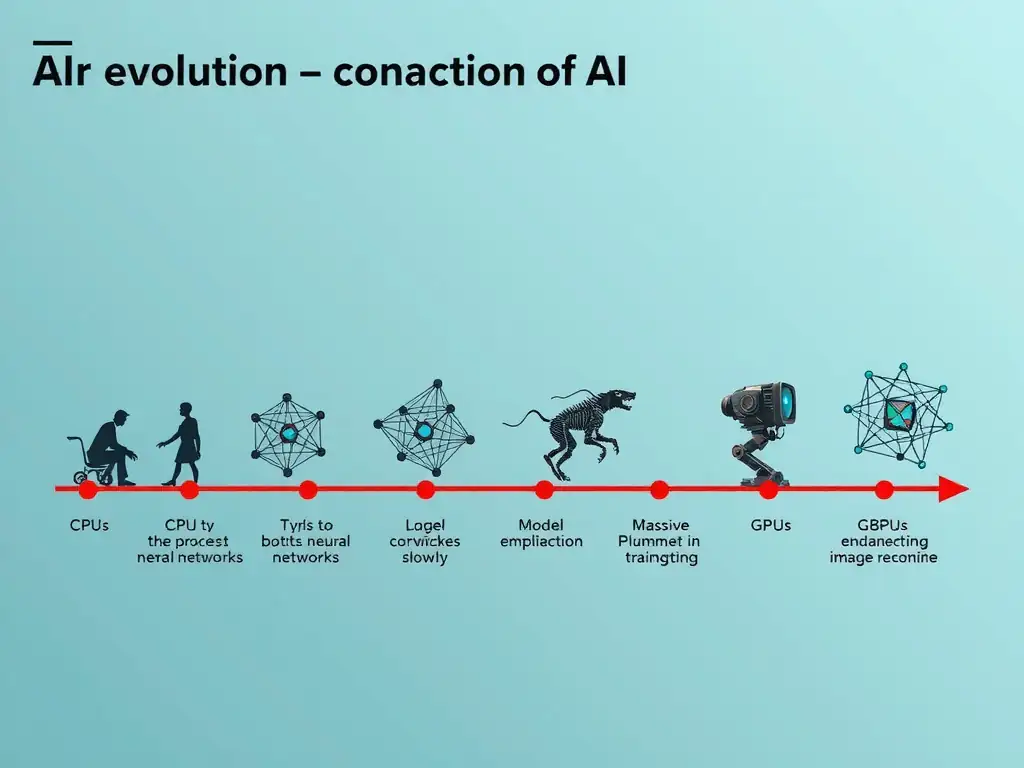
Here's the deal: the math behind neural networks has been around for decades, but GPUs changed everything. You can train huge image models fast because GPUs do the heavy parallel math that CPUs can't handle. Without that compute power, modern medical image recognition wouldn't scale.
Full Explanation
While many algorithmic concepts of artificial neural networks were developed in the late 20th century, they remained largely impractical for real-world tasks due to computational limitations. The recent breakthroughs in computer vision and deep learning, particularly for applications like medical image recognition, were primarily enabled by hardware acceleration.
Specifically, advances in GPU technology that allow high-speed parallel processing of large datasets transformed deep learning from a theoretical academic exercise into a highly practical industry tool. Deep neural networks require executing billions of matrix multiplications. GPUs, with their highly parallel architectures containing thousands of execution units, are uniquely suited for this type of math. By running these computations on GPUs instead of traditional CPUs, training times were cut by orders of magnitude. This allowed researchers to train much larger, multi-layer networks on vast datasets, unlocking high-accuracy image classification and object detection capabilities.
Let's analyze the incorrect choices: - The development of specialized AI programming languages that replaced Python and C++ is not the driver; the AI industry still relies heavily on established languages like Python and C++, using libraries such as PyTorch and TensorFlow compiled to run on GPU hardware. - Decreases in the physical size of solid-state drive storage media have helped with data management and storage economics, but they do not solve the fundamental computational bottleneck of training neural network weights. - The transition of healthcare systems to cloud-based data warehouses has helped with data management and storage economics, but it does not solve the fundamental computational bottleneck of training neural network weights.
Moreover, modern GPU developments such as dedicated Tensor Cores and high-speed NVLink interconnects have further accelerated this trend. They enable multi-GPU clusters to act as a single massive virtual compute resource, making the training of complex, multi-modal foundation models possible. Without these hardware improvements, modern AI applications would remain computationally infeasible.
Consequently, the evolution of GPU compute capability remains the single most impactful factor in the scalability and effectiveness of modern AI systems.