
You're managing an AI data center that handles both heavy model training and real-time user inference. Power costs are skyrocketing during peak daytime hours, and the grid is struggling to keep up. You need to rein in the energy bill without hurting the response times of your live user-facing services. Which approach will give you the best balance of energy savings and performance?
Select an answer to reveal the explanation.
Short Explanation
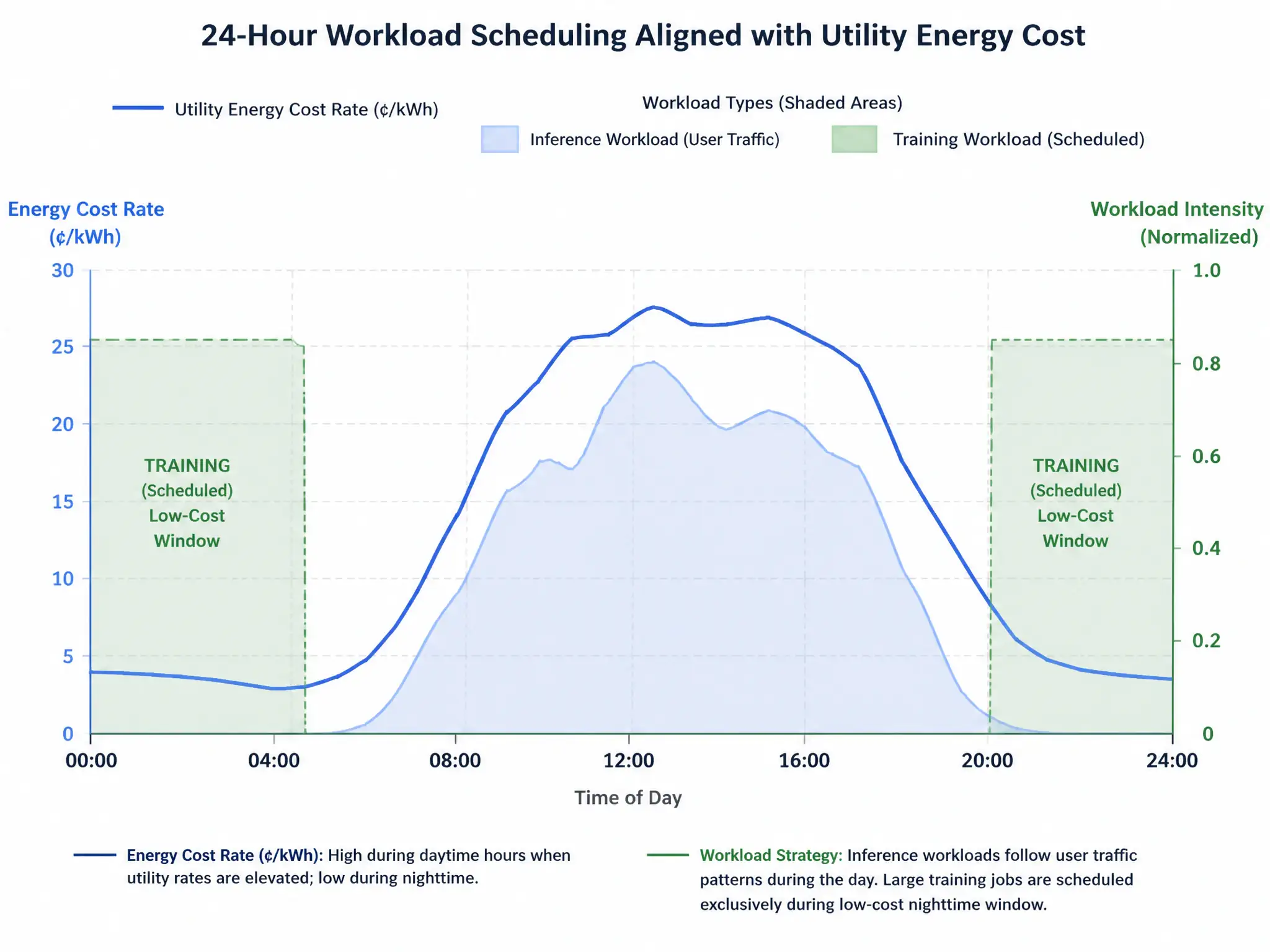
Training jobs can wait, but live inference can't. You should schedule non-urgent training during off-peak hours so daytime power goes to user-facing responses without slowing them down. That cuts energy costs without hurting performance.
Full Explanation
Data centers must manage two fundamentally different classes of workloads: model training, which is compute-intensive, long-running, and high-throughput but flexible regarding execution time; and inference serving, which is latency-sensitive and synchronous, requiring real-time response to user-initiated traffic. During peak daytime hours, electricity tariffs are high. Running both training and inference workloads simultaneously during these hours maximizes energy costs and puts pressure on cooling and power distribution systems. Implementing a workload scheduler that runs non-urgent training during off-peak hours is the most effective way to balance performance and energy costs. During peak hours, the data center runs only the essential, low-latency inference workloads. Overnight, the schedule boots up the training workloads when utility rates are lower and the data center's thermal load is easier to manage. The global GPU power-limit restriction is suboptimal because lowering GPU power limits reduces the maximum clock speed and compute capability of the GPUs. While it cuts peak draw, it directly increases execution latency, risking violations of inference SLAs. Migrating training to CPU servers during high-tariff periods is highly inefficient. Because CPUs lack the parallel architecture required for tensor mathematics, a training job will take significantly longer, resulting in higher total energy consumption over the lifetime of the run. Deploying liquid cooling across all nodes to directly cut raw electrical power draw improves thermal dissipation and permits higher rack density, but it represents a high CapEx investment and does not solve the underlying operational challenge of peak-demand energy management. Thus, workload scheduling provides the optimal strategy for balancing operational costs and performance SLAs.