
You're monitoring a multi-node GPU cluster during a high-traffic production run, and something is off. You notice processing response times are spiking, yet your dashboard shows GPU utilization is sitting at a comfortable 75%. If the GPUs aren't even maxed out, why is the pipeline backing up? What is the most likely culprit behind this bottleneck?
Select an answer to reveal the explanation.
Short Explanation
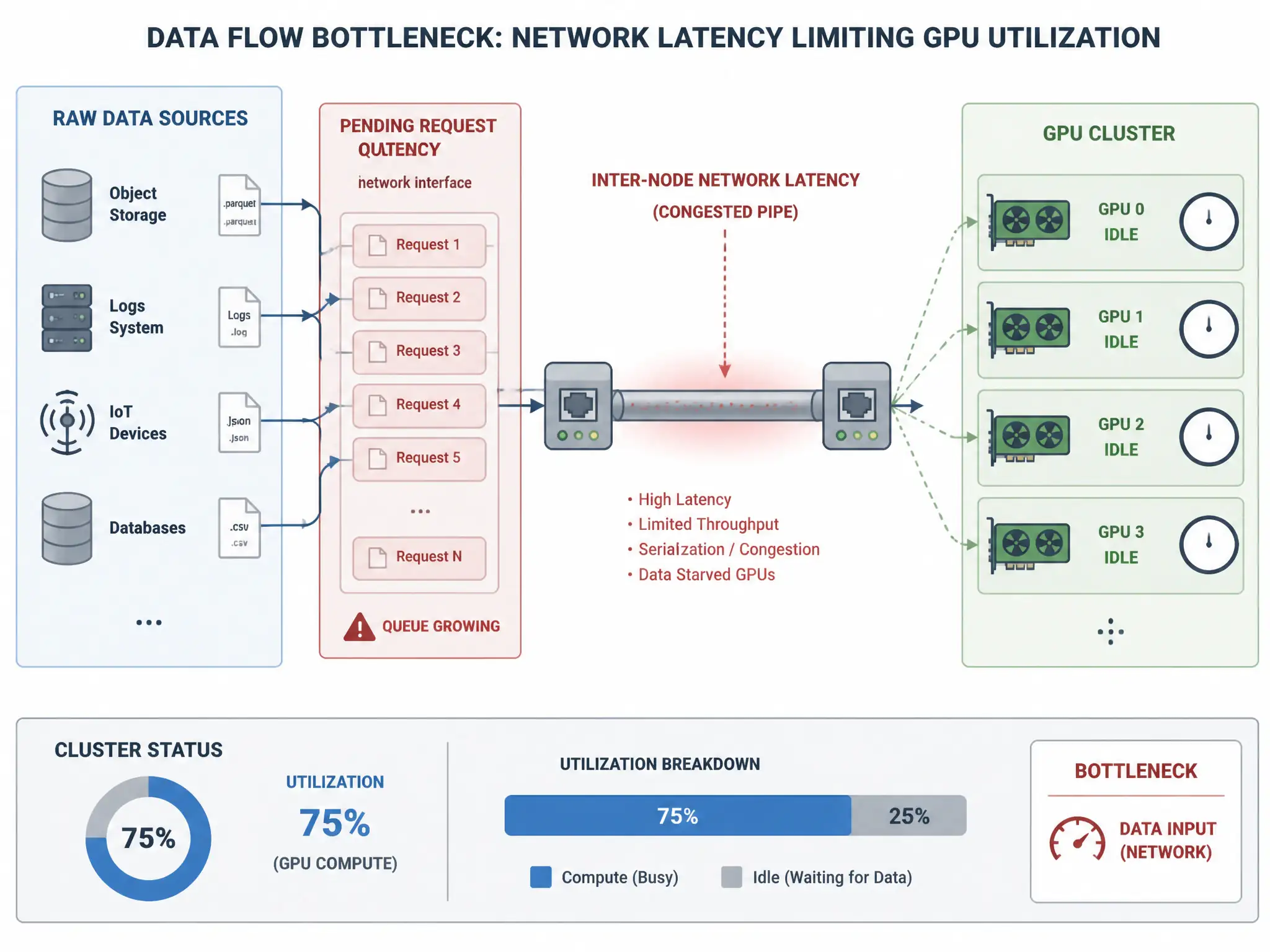
If your GPUs are only at 75% while response times spike, they're likely starved for data, not maxed out. In a multi-node cluster, slow or inefficient data transmission between nodes makes the GPUs wait. Fix the inter-node network path, not the GPU compute itself.
Full Explanation
In accelerated computing, a mismatch between low GPU utilization (e.g., under 80%) and high overall system latency indicates that the GPUs are "starved" of data. Rather than being bottlenecked by their own computational limits, the GPUs are spending a significant portion of their clock cycles waiting for data to arrive.
In a distributed multi-node AI cluster, this bottleneck is most frequently located in the inter-node communication fabric. During parallel execution, nodes must constantly exchange intermediate tensors, weights, and synchronization signals. If the network throughput is insufficient or latency is high, this communication phase becomes a barrier, delaying the start of the next computation step. Therefore, inefficient data transmission and latency between cluster nodes is the most likely culprit.
Evaluating the other choices: a severe bottleneck in local GPU memory bandwidth would still register GPU cores as active while waiting for data from local HBM, keeping GPU utilization high. High CPU utilization during raw data preprocessing can starve GPUs, but this would show up as 100% CPU utilization on the host; without that specific metric, inter-node network latency remains the most likely cause. Excessive allocation of GPU instances causing scheduler overhead might lead to lower resource efficiency, but it does not cause response latency spikes under peak load.
To resolve inter-node bottlenecks, data center architects deploy high-speed, low-latency interconnects (like InfiniBand) and software optimization layers (such as GPUDirect RDMA) to streamline data transfers between nodes.