You are designing the infrastructure for a hybrid enterprise cloud that supports diverse applications, including relational database transaction processing, deep learning model training, and heavy mathematical simulations. To optimize cost and performance, you must decide how to distribute these workloads between CPU and GPU compute pools. Which of the following guidelines represents the most efficient allocation strategy?
Select an answer to reveal the explanation.
Short Explanation and Infographic
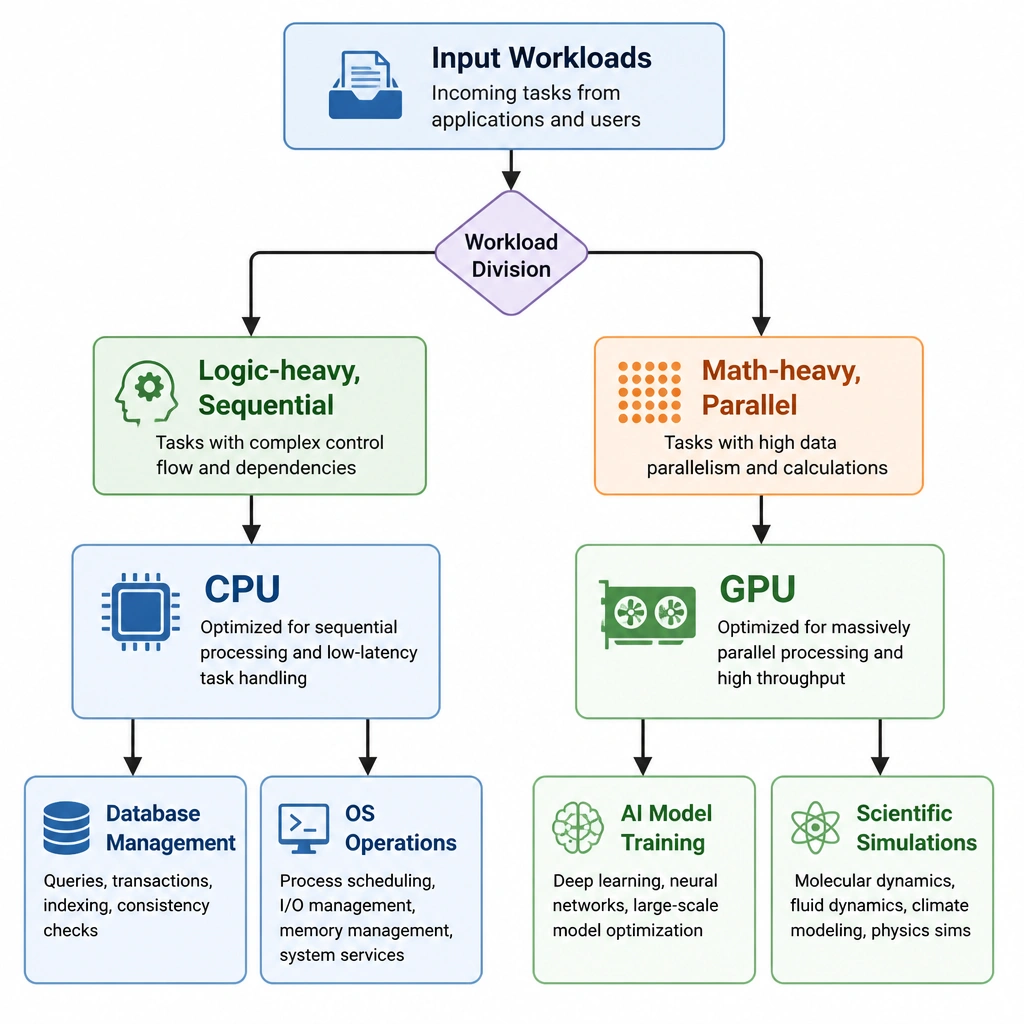
Imagine your boss walks in and says, "We're spending too much on cloud compute, and half our applications are running incredibly slow. Fix it by Friday!" You need to know which tool is right for the job. You can't just throw GPUs at everything. If you try to run a relational database query—which is full of complex rules, conditional logic, and sequential steps—on a GPU, it's going to crawl. Databases are CPU territory all day long. But if you have to run a massive simulation or train a neural network, a CPU will take forever because it's doing the math one step at a time. Put the parallel, heavy-math stuff on the GPUs, and keep the logic-heavy, step-by-step workloads on the CPUs. That's how you build a fast, cost-effective hybrid cloud.
Full explanation below image
Full Explanation
A well-architected cloud infrastructure relies on heterogeneous computing, matching specific workloads to the processing architecture that handles them most efficiently. Relational database management systems (RDBMS) rely on sequential execution, complex control flow, I/O operations, and branching logic (such as SQL query optimization, transaction serialization, and index lookups). CPUs are specifically engineered to minimize latency for these highly sequential, branch-heavy workloads using advanced control logic, branch prediction, and large cache hierarchies.
Conversely, deep learning training and scientific simulations involve performing repetitive, uniform mathematical calculations across massive datasets. These tasks are highly parallelizable because the calculations do not depend on complex conditional branching. GPUs, with their throughput-oriented design containing thousands of concurrent execution threads, are optimized to process these parallel tasks orders of magnitude faster than CPUs. Attempting to run sequential database management on a GPU would result in poor performance due to execution serialization (warp divergence) and memory transfer overhead. Similarly, running massive parallel AI training on a CPU is highly inefficient and costly. Therefore, segregating workloads based on their parallel or sequential nature is the optimal approach.