When selecting hardware for training deep learning models, engineers heavily favor GPUs over traditional CPUs. What architectural characteristic of GPUs provides the primary performance advantage for executing machine learning operations?
Select an answer to reveal the explanation.
Short Explanation and Infographic
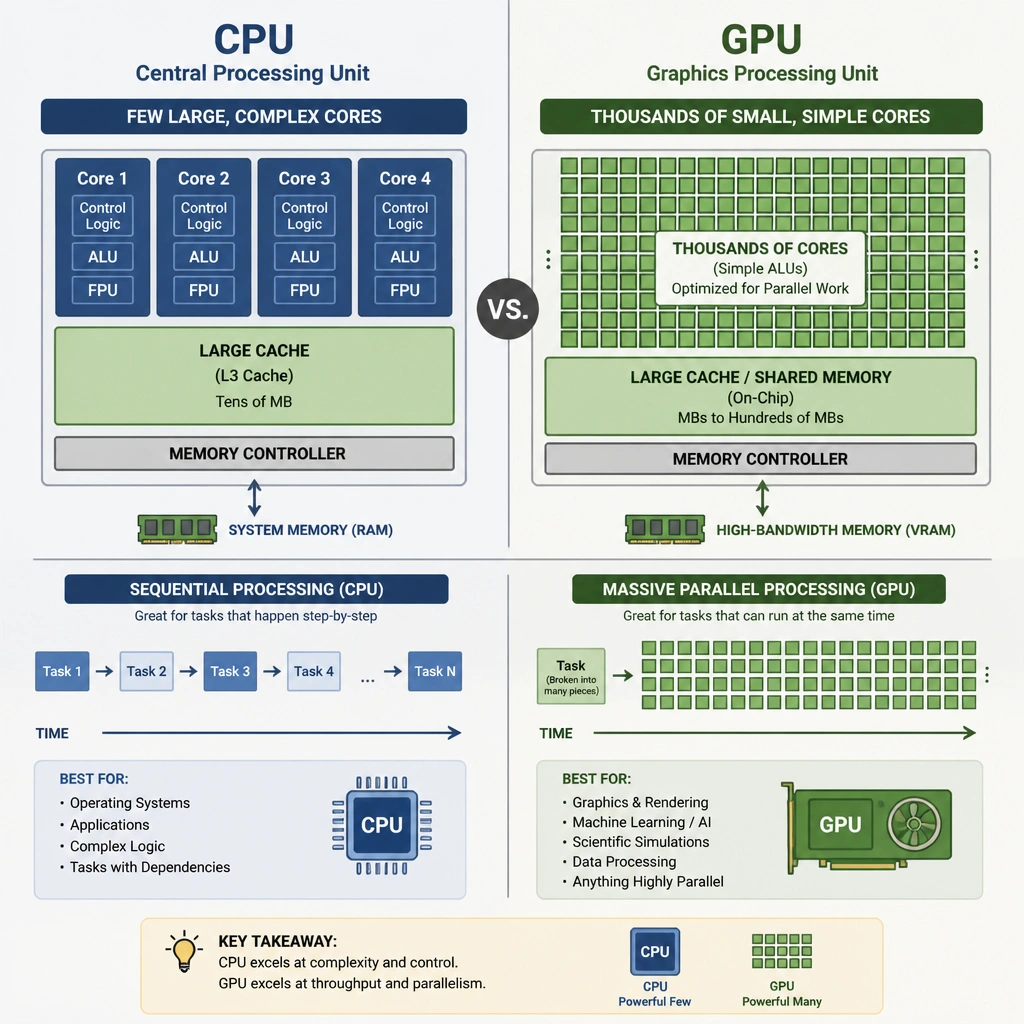
Think of it like this: a CPU is like a Ferrari. It has a super-fast engine and can run complex tasks one after the other incredibly quickly. But if you have to move a million tiny boxes across town all at once, that Ferrari isn't going to help you much. You need a fleet of thousands of delivery trucks instead. That fleet is your GPU. A GPU has thousands of small, simple cores working together. Since deep learning is basically just doing billions of simple math operations (like matrix multiplication) at the exact same time, the parallel power of a GPU completely crushes a CPU. It's not about doing one calculation faster; it's about doing thousands of them simultaneously.
Full explanation below image
Full Explanation
The fundamental difference between CPUs and GPUs lies in their design philosophies. A CPU is designed for general-purpose computing and is optimized for low-latency sequential processing. It features a relatively small number of powerful cores with large caches and sophisticated instruction pipelines, allowing it to handle complex branching logic and execute sequential tasks very quickly. In contrast, a GPU is designed for throughput-oriented computing, specifically for processing large blocks of data in parallel. A GPU contains thousands of smaller, simpler cores designed to execute the same instruction on multiple data points simultaneously (Single Instruction, Multiple Data, or SIMD).
Deep learning and artificial intelligence workloads are mathematically dominated by linear algebra operations, such as matrix multiplications and vector additions. These computations can be broken down into millions of independent arithmetic operations that can run concurrently. A GPU's highly parallel architecture allows it to process these operations in parallel, reducing training times from weeks on a CPU to hours on a GPU. While a CPU must process these matrix operations in a more sequential manner, a GPU distributes the load across its thousands of cores. Note that GPUs do not inherently improve model accuracy or prevent overfitting; those are properties of the model architecture, training data, and hyperparameter tuning. Additionally, CPUs typically have access to much larger system memory pools than the onboard VRAM of GPUs.