You are administering a Kubernetes-based AI cluster where researchers run a mix of workloads: some are long-running, multi-GPU training jobs, while others are quick, single-GPU inference tests or high-memory preprocessing steps. To maximize cluster efficiency and keep queue times short, you need to automate resource allocation so that compute and memory resources are assigned based on real-time demands and current node availability. Which of the following scheduling methods is the most appropriate?
Select an answer to reveal the explanation.
Short Explanation and Infographic
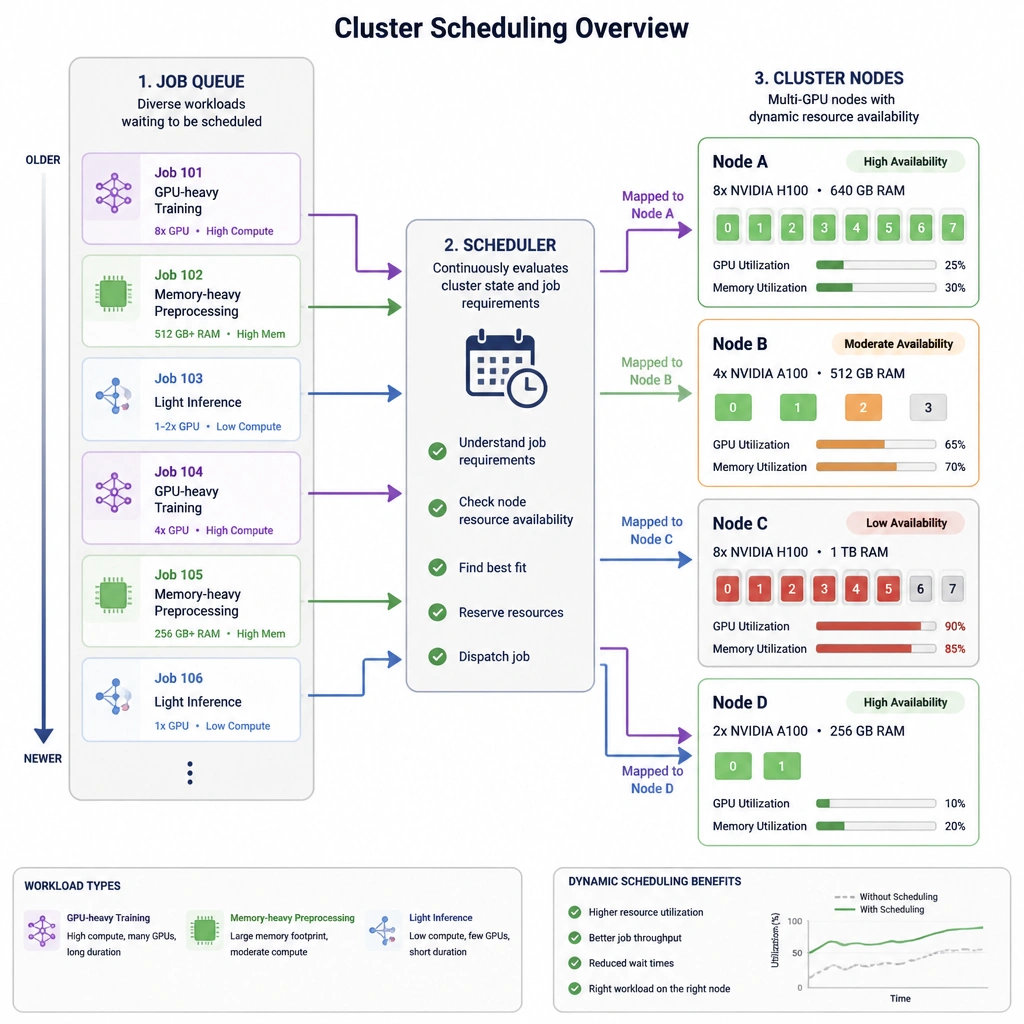
Here's the deal: running a busy AI cluster is like managing a busy kitchen. If you have some chefs who just need a toaster and others who need the entire industrial oven, you can't just hand everyone the exact same tools or make them wait in a single-file line forever. That's a recipe for empty stoves and angry customers! If you manually assign tasks, you'll spend your whole day playing traffic cop and still get it wrong. A dynamic scheduler is your smart kitchen manager. It looks at what each job actually needs right now—high memory, multiple GPUs, or just a quick slice of compute—and checks which nodes have free space in real time. It keeps the hardware hot and the job queue moving.
Full explanation below image
Full Explanation
Managing heterogeneous AI workloads requires an orchestration system that can dynamically evaluate and assign resources. Workloads in deep learning environments are rarely uniform: training runs typically demand high GPU compute and memory bandwidth for extended periods, whereas validation or inference tasks require lower latency and fewer compute resources. A dynamic scheduler (such as Kubernetes with specialized schedulers like Volcano or custom resource estimators) solves this by continuously monitoring cluster telemetry, node capacity, and queued job specifications. It makes scheduling decisions in real time, packing nodes efficiently (bin packing) and dynamically scaling resources up or down to maximize overall throughput and minimize job latency.
Alternative approaches introduce severe operational bottlenecks. Static or even round-robin distribution of resources assumes all workloads are identical, which leads to massive resource waste where low-requirement jobs sit on idle GPUs while intensive jobs are throttled. Manual assignment is not scalable, prone to human error, and unable to adapt to real-time changes in cluster state or job execution. A strict first-in-first-out (FIFO) queue without resource awareness can cause head-of-line blocking, where a massive training job halts all subsequent minor tasks, dramatically increasing overall wait times. Therefore, dynamic scheduling is essential for maintaining optimal efficiency in mixed-use AI clusters.