Deep learning algorithms rely heavily on massive matrix multiplications and tensor operations. Which hardware architectural characteristic of modern Graphics Processing Units (GPUs) makes them vastly superior to Central Processing Units (CPUs) for these specific tasks?
Select an answer to reveal the explanation.
Short Explanation and Infographic
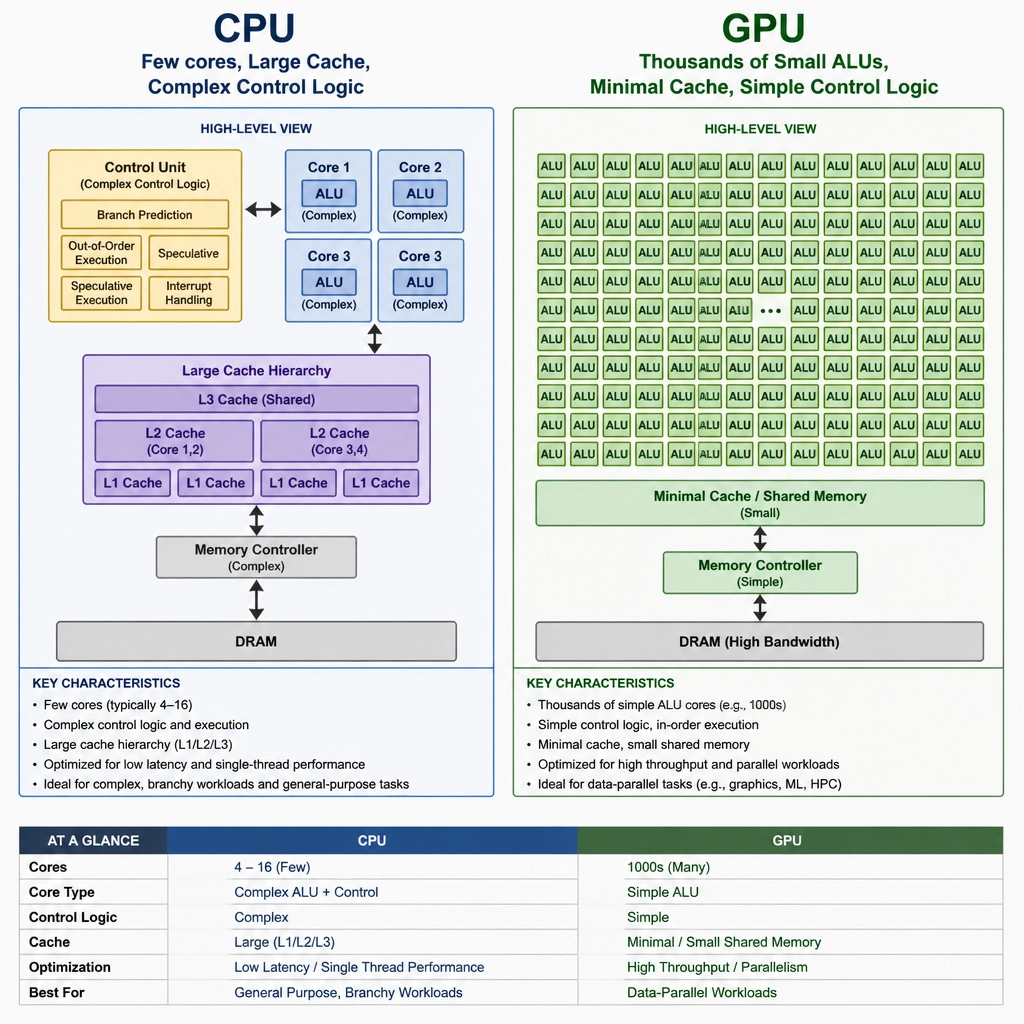
Check this out: a CPU is like a high-speed sports car. It has a few very fast cylinders (cores) and is amazing at running one sequential task after another, dealing with complex logic and branch prediction. But deep learning isn't a single complex task — it's millions of simple math problems (like matrix multiplications) happening at the exact same time. A GPU is like a massive bus system. It might move slower than the sports car in terms of clock speed, but it can carry thousands of passengers (calculations) at once because it has thousands of smaller cores working in parallel. That massive parallel processing capability is the secret sauce that makes GPUs the absolute kings of training and running deep learning models!
Full explanation below image
Full Explanation
Deep learning workloads consist primarily of large-scale mathematical operations, such as matrix multiplications and convolutions, which can be executed independently. - GPUs are designed with a throughput-oriented architecture containing thousands of smaller, simpler cores optimized for Single Instruction, Multiple Data (SIMD) or Single Instruction, Multiple Threads (SIMT) operations. This allows the GPU to process thousands of mathematical calculations concurrently, which aligns perfectly with the matrix math required by neural networks. - High clock speed is a characteristic of CPUs. CPUs have high clock frequencies (often 3-5 GHz) to execute sequential instructions rapidly, whereas GPUs run at lower clock speeds (typically 1-2 GHz) but compensate with massive parallelism. - A large cache hierarchy and branch prediction is also a CPU feature designed to minimize latency in complex sequential code paths. GPUs allocate most of their die area to Arithmetic Logic Units (ALUs) rather than large caches and control logic. - Low power consumption is incorrect; high-performance data center GPUs actually consume significant amounts of power (often 300W to 700W+ per GPU).