A medical imaging department is implementing a deep learning system to detect anomalies in high-resolution MRI scans in real-time. However, when the system processes large, high-resolution volumetric images, inference latency spikes, which is unacceptable for real-time diagnostic assistance. What is the most effective approach to reduce inference latency without sacrificing diagnostic accuracy?
Select an answer to reveal the explanation.
Short Explanation and Infographic
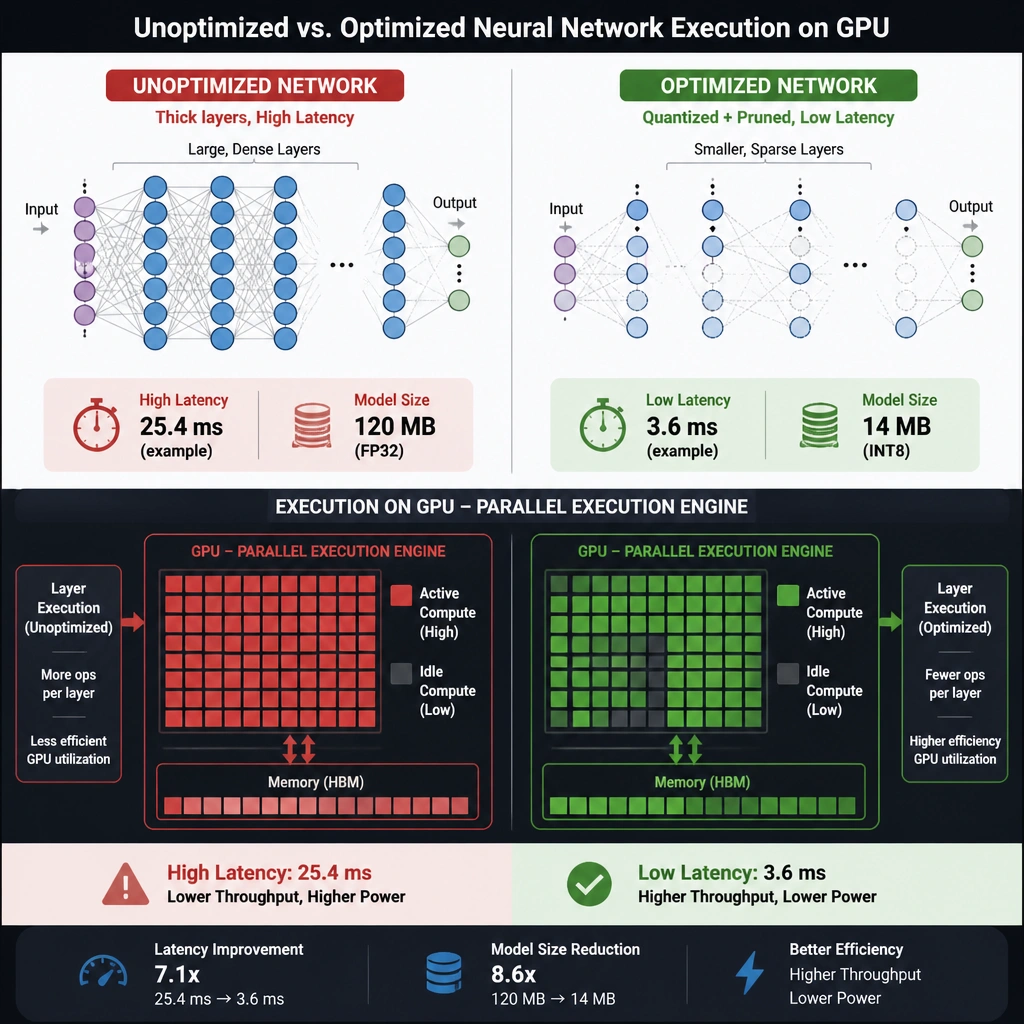
Here's the deal: in medical imaging, cutting corners is not an option. If you downsample those high-res MRI scans just to speed up the network, you're going to lose critical details, and that leads to misdiagnoses. Not good! And moving to CPUs? Forget about it — CPUs just don't have the parallel horsepower that deep learning demands. What you need to do is optimize the model's architecture itself so it plays nice with the GPU's parallel cores. Think of techniques like pruning — which trims away unused weights — or quantization to run calculations using smaller data types like FP16 or INT8. This makes the model lighter and faster, allowing the GPU to crunch through those high-resolution images in parallel without breaking a sweat or losing accuracy.
Full explanation below image
Full Explanation
High-resolution medical imaging workloads (such as MRIs or CT scans) require massive computational power for real-time inference. When performance degrades, modifying the inputs or reverting to sequential processing platforms is counterproductive or dangerous to diagnostic quality. - Optimizing the neural network architecture (via model pruning, weight quantization, or using TensorRT to optimize layer operations) directly enables the model to leverage the GPU's parallel architecture more efficiently. This reduces the number of operations and memory bandwidth required, accelerating inference times while maintaining high accuracy. - Downsampling image resolution directly reduces the fidelity of the inputs, which can obscure critical clinical features and degrade diagnostic accuracy. - Migrating to CPUs is incorrect because CPUs lack the thousands of parallel cores found in modern GPUs, which would severely worsen inference latency for complex deep learning models. - Adding system RAM addresses storage buffering but does not solve the compute bottleneck of the model execution itself on the GPU.